Sheffield Resources Makes New Discoveries South of Thunderbird

THE DRILL SERGEANT: Sheffield Resources (ASX: SFX) announced a trifecta of discoveries from regional exploration drilling undertaken at the Buckfast, Bohemia and Concorde prospects at the company’s Dampier mineral sands project near Derby in northern Western Australia.

Sheffield Resources claimed the three new discoveries saying they are located between 40km and 55km south of the company’s world class Thunderbird mineral sands project.

The latest results from the drilling include the following broad, high-grade intervals:

BUCKFAST

NLAC025
46.5 metres at 5.5 per cent heavy minerals (HM) from 57m, including 21m at 9.12 per cent HM from 64.5m;

NLAC023
33m at 4 per cent HM from 61.5m, including 21m at 5.2 per cent HM from 66m; and

NLAC027
37.5m at 5.01 per cent HM from 67.5m, including 25.5m at 5.74 per cent HM from 75m.

BOHEMIA

NLAC018
43.5m at 2.35 per cent HM from 16.5m, including 10.5m at 4.25 per cent HM from 25.5m.

Sheffield explained these results conclude its 2018 regional exploration drilling program and follow the recently announced discoveries at the zircon-rich Night Train deposit and the Cold Duck, Porphyry Pearl, Cisco and Nomad prospects.

The drilling program targeted additional large, zircon-rich deposits suitable for downstream processing at the Thunderbird Dry Mineral Separation Plant.

Sheffield has now identified fourteen zones of mineralisation along a 160km long highly mineralised trend which extends from Seagull in the north to Runaway in the south.

This includes the Thunderbird deposit which has a Mineral Resource of 3.23 billion tonnes at 6.9 percent HM above a 3 per cent HM cut-off (Measured, Indicated and Inferred), including a high-grade component of 1.05 billion tonnes at 12.2 per cent HM above 7.5 per cent HM cut-off (Measured, Indicated and Inferred).

“The outstanding results received from this year’s regional drilling program have exceeded expectations,” Sheffield Resources managing director Bruce McFadzean said in the company’s announcement to the Australian Securities Exchange.

“Our recent low-cost exploration program has delivered multiple mineral sands discoveries within a 160km long underexplored and highly fertile region controlled by Sheffield.

“These new discoveries, including the zircon-rich Night Train deposit, are all located in close proximity to the world class Thunderbird deposit, adding to the growing global significance and strategic value of the Dampier Mineral Sands Project.

“As we close in on development of the world class Thunderbird project, we will continue to progress all funding options including ongoing discussions with potential strategic partners.”


Email: info@sheffieldresources.com.au

Website: www.sheffieldresources.com.au


Metalicity Applies for Pilbara Copper ELAs

THE BOURSE WHISPERER: Metalicity (ASX: MCT) has lodged Exploration License Applications (ELAs) in the Paterson Province of the Pilbara Region of Western Australia.

Metalicity has made the applications for ground adjoining Rio Tinto’s Exploration Licenses within an interpreted copper corridor, which it considers hosts numerous underexplored copper occurrences and geophysical anomalies.

The company explained the project generation builds on a copper prospectivity study it completed over the Pilbara region, including the Paterson Province, aligning with its strategy to focus on nickel and copper exploration.

This strategy meant the Fraser Range and Paterson Province emerged as its preferred geological terrains.

Metalicity has commenced data compilation and project evaluation to ascertain areas of interest within the Desert Queen and Mandora Beach ELAs for possible future exploration.

“The Paterson ranks highly on our list of prospective geological terrains for the discovery of copper mineralisation in the Pilbara and we are encouraged the by activity of the major companies nearby which supports our prospectivity models,” Metalicity managing director Matt Gauci said in the company’s announcement to the Australian Securities Exchange.

“Metalicity retains significant experience exploring the Paterson over the last 20 years and is currently compiling all available geological, geochemical, geophysical datasets to assist guiding future exploration activities.”


Website: www.metalicity.com.au


Pilbara Minerals Gives Pilgangoora Stage 2 the Nod

THE BOURSE WHISPERER: Pilbara Minerals (ASX: PLS) has made the Final Investment Decision (FID) for the Stage 2 expansion to five million tonnes per annum of the company’s 100 per cent-owned Pilgangoora lithium-tantalum project in Western Australia’s Pilbara region.

Pilbara Minerals’ Board endorsed the continued expansion of Pilgangoora, subject to obtaining necessary regulatory approvals and securing the balance of project funding.

The company said the decision followed completion of a Definitive Feasibility Study, 100 per cent of the Stage 2 offtake being sold to high-quality customers and general support from the customer base to continue to expand the Pilgangoora operations.

Pilbara Minerals outlined progress with a number of funding alternatives for Stage 2, including debt and/or offtake prepayment funding from customers linked to accessing Stage 2 product as well as other alternate finance structures.

Stage 2 project works are continuing with the company confident of meeting its objective of commissioning Stage 2 from the December quarter, 2019.

Stage 1 development continues to progress with Pilbara Minerals’ shipping its second shipment of spodumene concentrate from Port Hedland in the second half of October with 6.3 per cent lithium oxide (Li2O) onboard.

Production from Pilgangoora Stage 1 is also sticking to the script with the progress being made in the continued ramp-up and optimisation of production.

“Pilbara Minerals has established a track record of getting things done – developing at scale, successfully executing a rapid build and ramp-up of the Stage 1 project and confirming our ability to deliver high-quality products to our customers,” Pilbara Minerals managing director Ken Brinsden said in the company’s announcement to the Australian Securities Exchange.

“These achievements and more have allowed us to attract and grow production with premium customers in the global lithium-ion supply chain.

“Against a backdrop of significant demand growth for lithium raw materials over the coming decade, the quality and scale of the resource at our Pilgangoora project demands further expansion.

“This will ensure it becomes a mainstay in the next generation of large-scale, low-cost mines to support the significant growth in downstream lithium hydroxide capacity.

“In much the same way as we got on with the job in Stage 1, we will work to the same tune in Stage 2.”


Website: www.pilbaraminerals.com.au


Core Exploration Encounters New Lithium at Lees and Booth Prospects

THE DRILL SERGEANT: Core Exploration (ASX: CXO) announced exploration results from drilling carried out between the Lees and Booths prospects at the company’s Finnis lithium project in Northern Territory.

Core Exploration claimed the results support its exploration model that the two prospects are geologically linked.

The results come after Core compiled evidence of a link between the lithium rich pegmatites at Lees and Booths and immediately commenced a RC drill campaign to test the model.

A program consisting an additional 10-15 holes has been completed and the company has received results from the first 10, all of which encountered at least one pegmatite intersection of around six to 23 metres thick.

Most holes contain multiple intersections of pegmatite the company said can be tied with reasonable confidence to pegmatite intersections in holes along strike and down-dip.

Although it is yet to receive any assay results for the current round of drilling to date, based on visual estimates from drill chip samples and results from previous drilling, Core suggested it expects the pegmatites to be variably mineralised with spodumene.

The company said the discovery and delineation of a buried pegmatite swarm at Lees-Booths provides confidence that the Bynoe Pegmatite Field has other concealed spodumene pegmatite deposits, which it signalled it will work methodically to discover and define to provide a production pipeline for the Finniss project.

“These exploration results demonstrate the potential to uncover large blind spodumene-rich pegmatite swarms at the Finniss lithium project,” Core Exploration managing director Stephen Biggins said in the company’s announcement to the Australian Securities Exchange.

“The historic pits and workings at Lees and Booths are likely to be just a small surface footprint of more extensive pegmatites buried under thin cover in the area.

“The remainder of 2018 is shaping up to be a very busy one for Core as we continue to progress Grants towards development whilst examining the drilling data at a number of other prospects to bring these into the project’s resource inventory.”


Email: info@coreexploration.com.au

Website: www.coreexploration.com.au


Corazon Mining Expands Cobalt Ridge Mineralisation

THE DRILL SERGEANT: Corazon Mining (ASX: CZN) announced assay results from a recently completed drilling program at the company’s Mt Gilmore cobalt-copper-gold project in New South Wales.

Corazon Mining completed the drilling, which was focused on the Main Lode at the Cobalt Ridge deposit, a cobalt dominant sulphide deposit.

Assay results have been returned from the drilling program that included 21 holes, comprising reverse circulation (RC) and core drilling.

Drilling has demonstrated the east-west trending Main Lode to be up to 35 metres in width and has now been tested over an approximate 300 metre strike with drilling focused on depths predominantly less than 170 metres below surface.

The broad Main Lode includes multiple narrow, higher-grade sulphide rich lodes and returned numerous assays of over one per cent cobalt.

The best result from this program was a high-grade intersection of 5 metres at 2.14 per cent cobalt.

“This drilling has returned exceptional results and has enabled us to gain a much higher-level geological understanding of the deposit,” Corazon Mining managing director Brett Smith said in the company’s announcement to the Australian Securities Exchange.

“Our ongoing work should enable us to more accurately express the potential of the Cobalt Ridge deposit, which is our core aim, and we expect to be able to announce more about this in the coming weeks.”

Corazon Mining said Cobalt Ridge remains substantially under-drilled and there is demonstrated potential to define additional areas of mineralisation.

The company said the results from this current drilling program had provided a much better understanding of the controls on the mineralisation – knowledge it will put to use to identify additional drilling targets within Cobalt Ridge, as well as regionally with the greater Mt Gilmore project area.


Email: info@corazon.com.au

Website: www.corazon.com.au


Targets Starting to Shine at Little Gem

THE INSIDE STORY: Blackstone Minerals (ASX: BSX) is progressing the development of the company’s world-class Little Gem cobalt-gold project in the Canadian province of British Columbia.

To say Blackstone Minerals has been busy throughout the month of October would be an understatement as a steady flow of news from the Little Gem project continued to keep market watchers interested as advances emerged.

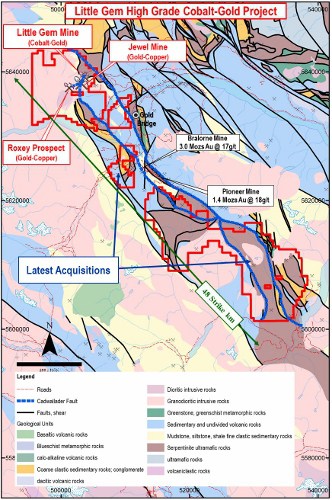
The company released results from phase two of a completed IP survey at the Jewel copper-gold-cobalt prospect, located 1.1 kilometre north-northeast of the Little Gem prospect.

The Jewel copper-gold-cobalt prospect is associated with the high-grade Jewel underground mine with historic production of 51 tonnes mined between 1938 and 1940.

This production was impressive, returning average mined grades of 73 grams per tonne gold and 0.4 per cent copper with highest grades assayed up to 243g/t gold and 19.2 per cent copper.

These historic grades were supported by Blackstone Minerals’ rock chip samples of up to 98g/t gold, 3.2 per cent copper, 0.1 per cent cobalt.

At over one kilometre long, the recently-defined IP anomalies are much larger and stronger than phase one anomalies Blackstone had previously announced and were interpreted by the company to indicate a large sulphide bearing body associated with the Jewel copper-gold-cobalt prospect.

The new large-scale IP anomalies were also judged to be coincidental with strong geochemical anomalies and favourably located within a major structural setting near the contact between the granodiorite and serpentinite that Blackstone has previously thought as an analogous geological setting to the deposits of the world class Bou-Azzer primary cobalt district in Morocco.

As the Jewel prospect has never been drill tested, Blackstone immediately designated these new, high quality IP anomalies, to be priority drill targets.

“Our field work indicates Jewel is associated with anomalous cobalt mineralisation and with the recent Erebor Cobalt-Gold discovery nearby the Little Gem project is shaping up to be a world class cobalt district,” Blackstone Minerals managing director Scott Williamson said.

“The Petrophysical analysis we completed on core samples from Little Gem indicate the sulphide alteration associated with the cobalt and gold mineralisation at Little Gem has a high IP response.

“These IP/ resistivity surveys have highlighted targets that are consistent with the measured response from Little Gem but significantly larger in size.”

The sulphide ore that was mined at the Jewel mine in the late-1930s was unable to be substantially beneficiated by concentration, resulting in gold values that were not high enough to make a profit by way of direct shipping ore (DSO) to smelters.

Only a small tonnage of ore was extracted at Jewel, after which the claims lapsed and there was no further work conducted at the prospect until Blackstone Minerals acquired its BC cobalt project approximately 12 months ago.

Since acquiring the project, Blackstone has completed an extensive program of prospecting, stream sediment and soil sampling with the geochemical results coinciding and supporting the large-scale IP chargeability and resistivity signatures at Jewel.

The next news to emanate from Blackstone Minerals’ newswire was the receipt of assay results, confirming its Erebor discovery at the Little Gem project.

The results stemmed from surface rock chip samples taken from the Erebor cobalt-gold discovery, located 900 metres along an interpreted ultramafic trend to the south-west of the historic Little Gem adits.

Blackstone claimed the high-grade samples represent the first discovery of substantial cobalt-gold mineralisation in the region since prospectors found similar mineralisation known as Erythrite in the 1930s by identifying a pink cobalt-bloom on weathered mineralisation which led to the discovery of the Little Gem cobalt-gold project.

High-grade cobalt assays from surface rock chip samples taken from the Erebor discovery included:

2.3 per cent cobalt, 32 grams per tonne gold and 1.1 per cent nickel;
1 per cent cobalt;
1 per cent cobalt;
0.6 per cent cobalt;
0.5 per cent cobalt; and
0.4 per cent cobalt.

High-grade gold and copper assays were also recorded from surface rock chip samples taken from the Erebor discovery, including:

16.7g/t gold and 1.6 per cent copper;
10.4g/t gold; and
1.5 per cent copper.

“These high-grade assays confirm the Erebor discovery as the first known occurrence of high-grade cobalt-gold mineralisation in the region since prospectors identified similar mineralisation in the 1930s, which led to the initial discovery of Little Gem,” Williamson said.

“The Erebor discovery opens up the potential for multiple targets similar to the Bou-Azzer primary cobalt district in Morocco and combined with the recent IP survey results see the Bridge River Mining Camp emerging as a potential world class cobalt belt located in a tier one mining jurisdiction in British Columbia, Canada.”

More news, however, was to emerge from the Jewel prospect in the form of results from further soil sampling that identified major copper-gold-cobalt targets centred on the Jewel prospect.

The new soil anomalies are greater than 1.5 kilometres long and coincide with the earlier IP survey results that indicated a large sulphide bearing body associated with the prospect.

The later surface rock chip samples taken from the Jewel prospect delivered high-grade assay results including:

5.6 per cent copper; and
5.1 per cent copper.

Blackstone signalled these results, combined with its earlier efforts, had made the Jewel prospect the company’s highest priority target to be drill tested at the earliest opportunity.

“Our soil sampling program has identified a major copper-gold-cobalt target at Jewel which coincides with the large IP anomaly we believe to be a substantial sulphide bearing body at depth,” Williamson said.

“We are eagerly anticipating the drilling of these new targets so as to better understand the primary source of the high-grade copper-gold-cobalt mineralisation at Jewel, Little Gem and Erebor.

“We look forward to further results from our 2018 fieldwork program as we continue to unlock what is shaping up to be a potential world class cobalt district.”

Blackstone has already completed an initial six diamond drill holes at Little Gem and at the time of writing was awaiting assay results for the remaining five diamond drill holes.

Drilling to date has intersected the Little Gem structure within metres of the interpreted target.

The 2018 drilling to date has consistently intersected a broad alteration zone, highlighting potential for a major hydrothermal system at Little Gem.

Results from the first six drill holes at Little Gem include:

LGD17-001R1
1.1m at 3 per cent cobalt and 44g/t gold within 4.3m at 1 per cent cobalt and 15g/t gold;

LGD18-0022
1m at 1.2 per cent cobalt and 5g/t gold within 3.2m at 0.8 per cent cobalt and 4g/t gold;

LGD18-0033
0.4m at 1.2 per cent copper, 5g/t gold and 0.12 per cent cobalt within 1m at 0.5 per cent copper, 4g/t gold and 0.08 per cent cobalt; and

LGD18-0053
0.8m at 0.6 per cent cobalt and 9g/t gold within 1.6m at 0.4 per cent cobalt and 5g/t gold.

The carried out by Blackstone since acquiring Little Gem has also led to the discovery of the high-grade Roxey gold-copper prospect.

The Roxey gold-copper prospect is located 1.5km west-southwest of the Little Gem prospect and was visually identified by Blackstone during its due diligence site visit when rock chip samples were taken within the target area which assayed up to 24g/t gold, 1.9 per cent copper and 24g/t silver.


Blackstone Minerals Limited (ASX: BSX)
…The Short Story

HEAD OFFICE
Suite 3, Level 3
24 Outram Street
West Perth, WA, 6005

Ph: +61 8 9425 5217

Email: admin@blackstoneminerals.com.au
Web: www.blackstoneminerals.com.au

DIRECTORS
Hamish Halliday, Scott Williamson, Andrew Radonjic, Michael Konnert, Stephen Parsons


Mt Lindsay Tin Continues to Hold Venture Minerals’ Gaze

THE INSIDE STORY: Venture Minerals (ASX: VMS) is hoping the lithium-focused electronic car boffins can find room to introduce tin to their conversation.

With lithium dominating the battery world mind-set, some of what most pundits consider as the more traditional commodities, have been forced to share the back seat of the anticipated electric car revolution.

Nickel is one such example. The metal was fast becoming one of John Paul Young’s, Yesterday’s Heroes until it received a boost from an off-the cuff remark by Tesla boss Elon Musk in 2017.

Tin is another of these old-school commodities that is well-placed to enjoy a long-term future as an innovative, competitive and sustainable material.

There are plenty of uses in modern-day technology where tin is already a vital element.

These include solar panels where tin is making its mark on the next generation of cheaper solar cell materials, making ready to replace more expensive and nowhere near as abundant elements.

Tin has also been shown to make lithium-ion batteries last more than three times longer, positioning it as an obvious choice to meet the anticipated demand for better batteries in mobile phones, cameras, iPads and other mobile devices.

Of course, a new market for tin, as it is for all metals involved, is the use of lithium-ion batteries in hybrid and all-electric cars.

Tin gained a lot of domestic credence earlier this year when global powerhouse Rio Tinto presented at a battery metals conference in Perth.

Part of the Rio presentation was a slide showing the metals most impacted by modern technologies, ranked by the Massachusetts Institute of Technology (MIT).

Although Rio was using the information to push its Jadar lithium project in Serbia, using the MIT ranking to show lithium as the second most impacted metal, with the tin sitting above the market’s recent hot commodity, separated by a good amount of daylight.

MIT credited the result to tin’s applications across a range of modern technologies, ranging through autonomous and electric vehicles, advanced robotics, renewable energy, advanced computation and information technology.

Venture Minerals recognised this as the ideal time to raise the flag on the company’s Mount Lindsay project in Tasmania and immediately set a detailed reassessment of the project’s high-grade tin and tungsten Resource base in motion.

Venture Minerals has long-touted Mt Lindsay as being one of the world’s largest undeveloped tin projects, one that is ideally placed to take advantage of the recent rise in both interest and the price of tin.
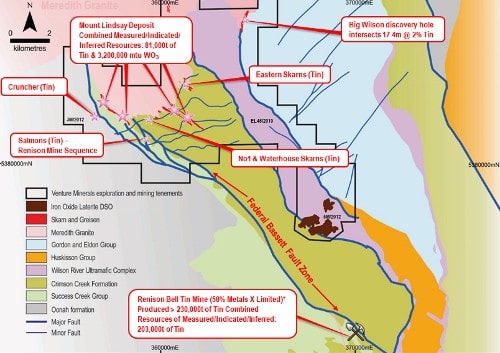
The 148 square kilometre Mt Lindsay project is in north-western Tasmania within the contact metamorphic aureole of the highly perspective Meredith Granite.

The project sits between the world class Renison Bell tin mine, which has produced more than 231,000 tonnes of tin metal since 1968, and the Savage River magnetite mine that has operated for over 50 years and currently producing approximately 2.5 million tonnes per annum of iron pellets.

Venture owns 100 per cent of the tenure that hosts both the Mt Lindsay tin-tungsten deposit and all surrounding prospects.

Since commencing exploration on the project in 2007, Venture has completed approximately 83,000m of diamond core drilling at Mt Lindsay, from which it has defined JORC compliant Measured, Indicated and Inferred Resources of 4.7 million tonnes at 0.4 per cent tin and 0.3 per cent WO3 with over 60 per cent in the Measured and Indicated categories.

A Feasibility Study completed on the project with comprehensive metallurgical test-work and post feasibility determined a very high-grade 75 per cent tin concentrate result Venture considers to likely attract price premiums.

In 2012, Venture Minerals claimed a major new high-grade tin discovery only six kilometres from the Mt Lindsay project when drilling encountered a 47-metre intersection of tin mineralisation at the Big Wilson prospect that included: 17.4 metres at 2 per cent tin, including 4m at 5.6 per cent tin.

Venture Minerals interpreted the results as being a combination of high-grade skarn style mineralisation and, typically large tonnage, greisen style mineralisation.

The high-grade nature of the earlier Big Wilson drilling opens depth opportunities, as these grades would be amenable to underground mining.

The company has made its intentions clear that it will be considering strategies to optimise the higher-grade portions at Mount Lindsay.

Venture will now look to focus on assessing the underground mining potential of this high-grade resource.

“Knowing that the Mount Lindsay project has a large tin Resource that could be harnessed to meet applications in Electrical Vehicles and renewable energy has refocussed the company to revisit its approach in developing this asset,” Venture Minerals managing director Andrew Radonjic told The Resources Roadhouse.

“Mt Lindsay is a very advanced project in Tasmania that has plenty of Resource tonnes but has a higher-grade core that we could approach from an underground perspective.

“We have a fair degree of confidence in developing an underground operation there.

“Instead of originally looking to maximise the Resource through mostly open pit mining 14 million tonnes of ore we would more likely be looking at mining four million tonnes from purely underground which we believe is the best way of bringing forward tin and tungsten production from Mount Lindsay.

“We also have a number of high-grade targets that we can follow up.”

While the potential of Mt Lindsay continues to mount, Venture Minerals is focusing most of its current attention on the company’s Thor VMS prospect in Western Australia.

Venture has identified nine priority VMS (Volcanogenic Massive Sulphide) drill targets from preliminary results it received from an EM (Electromagnetic) survey carried out at the prospect.

Venture’s continued exploration efforts on Thor follow its recent discovery of massive and semi-massive sulphides in reconnaissance drilling targeting a large historic EM anomaly.

The company anticipates final processing of the new detailed survey, which utilised the latest EM technology, will shortly be complete, from which it will prioritise the targets in preparation for immediate drilling.

There has been a great deal of activity at Thor in recent times, including:

Completion of a high-resolution Xcite™ Airborne EM survey by New Resolution Geophysics (NRG) over the Thor prospect delivering the nine priority VMS style drill targets;

Confirmation of large VMS style target sequence extending over 20 kilometres of strike;

A maiden drill program that intersected a 17m zone of disseminated, semi-massive and massive sulphides using portable XRF confirming the presence of zinc and copper; and

Recent assays confirming the presence of zinc and copper with core samples containing up to 0.3 per cent zinc and 0.2 per cent copper.

Venture has now commenced work on the recently granted northern tenement at Thor (E70/5067), which holds 14 strike kilometres of the Thor VMS target zone with a surface geochemical sampling program.

Thor has the same EM and geochemical signature as Teck’s adjacent VMS Kingsley discovery, which is one of several VMS occurrences in the Archean Yilgarn Craton of Western Australia with the Golden Grove Camp (Mine), 450kms north-east of Perth, being the prime example with over nine VMS deposits spread over 13kms of strike.

“The early success we enjoyed from the EM survey was highly-encouraging,” Radonjic said.

“We are now looking forward to testing some of the nine priority drill targets as soon as we can.”


Venture Minerals Limited (ASX: VMS)
…The Short Story

HEAD OFFICE
Suite 3, Level 3
24 Outram Street
West Perth, WA, 6005

Ph: +61 8 6279 9428

Email: info@ventureminerals.com.au
Web: www.ventureminerals.com.au

DIRECTORS
Mel Ashton, Andrew Radonjic, Hamish Halliday, John Jetter


Vango Mining Drills to Define Shallow Resource

THE DRILL SERGEANT: Vango Mining (ASX: VAN) announced it is continuing a drilling and development program at the Trident high-grade gold deposit, part of the Trident gold project on the company’s 100 per cent-owned Plutonic Dome (Marymia) gold project in the Mid-West region of Western Australia.

Vango Mining has RC drilling and geotechnical diamond drilling underway to define near/at surface expression of the high-grade gold mineralisation at the Trident gold project with the intent to provide information to determine the viability of developing an open pit and underground portal access point on the shallow mineralisation at the western end of the Trident gold deposit, referred to as Trident West.

The company will drill a further five RC and possibly pre-collared diamond drillholes to test the shallow, up-plunge, projection of the Trident gold deposit to the west of the very-high grade core of the deposit that was drilled previously.

The geotechnical drilling program will include four HQ3 diameter diamond drillholes within the proposed open pit target area at Trident West to determine ground conditions and test structures that will impact on open pit wall angles and stability and assist the design and optimisation of the proposed open pit/portal access.

In addition to Trident, Vango will drill down-plunge extensions of the Cinnamon gold deposit.

Two to three pre-collared diamond drillholes will be carried out to ensure target depth is reached and to generate structural information on the deeper extensions of the deposit.

The first of the latest pre-collared diamond drillholes has been completed (VBGRCD003) and intersected mineralisation in the target zone.

Vango is currently waiting to receive results of this hole.

“The company’s strategy is to add further resources to the project’s development pipeline, which currently includes the Trident high-grade gold deposit as the primary target,” Vango Mining said in its ASX announcement.

“Vango aims to develop the project into a significant, stand-alone, gold mining and processing operation with outstanding upside potential to continually build the high-grade gold resource base.”


Website: www.vangomining.com.au


Calidus Encounters Further High-Grade Gold at Warrawoona

THE DRILL SERGEANT: Calidus Resources (ASX: CAI) released the latest high-grade drilling results achieved from the St George Shear and Klondyke East prospects at the company’s Warrawoona gold project in Western Australia.

Calidus Resources said the reustlts had confirmed extensions to the current Resource area at the Warrawoona project.

The company explained the drilling is part of a larger resource infill and extension program it has going to expand the current 712,000 ounce Warrawoona resource leading to the commencement of a pre-feasibility study in 2019.

Infill drilling for open-pit resources at the new high-grade gold zone St George, 150m North of the Klondyke Main resource, returned intercepts including:

18SGRC031
6 metres at 7.61 grams per tonne gold, including 1m at 40.64g/t gold from 16m;

18SGRC032
8m at 5.64g/t gold, including 1m at 11.03g/t gold, 1m at 13.05g/t gold and 1m at 10.95 g/t gold from 44m;

18SGRC047
14m at 1.77g/t gold from 35m; and

18SGRC050
2m at 10.23g/t gold, including 1m at 18.91g/t gold from 91m.

Klondyke East in-fill drilling returned the following:

18KLRC152
2m at 20.84g/t gold, including 1m at 40.51g/t gold from 88m;

18KLRC148
6m at 3.82g/t gold from 93m;

18KLRC172
15m at 0.97g/t gold from 97m;

18KLRC157
2m at 7.29g/t gold, including 1m at 12.75g/t gold from 66m; and

18KLRC158
1m at 10.79g/t gold from 2m.

“The ongoing multi-target drilling programs at the Warrawoona gold project continue to be very successful, aiming to build on the landmark 712,000 ounce resource we delivered in December 2017 and clearly showing that the project has considerable upside,” Calidus Resources managing director Dave Reeves said in the company’s announcement to the Australian Securities Exchange.

“The high-grade tenor of the St George Shear intercepts is very encouraging especially considering its location being only 150 metres north of the Klondyke deposit.

“With still 60 per cent of this area to report and the tenor of grade increasing to the west, I look forward to reporting these further results and the results of an initial diamond drill program that is targeting resources beneath the potential open pit at Klondyke.

“This drilling is now complete with drill rigs now moving to complete geotechnical drilling and water bore drilling for the upcoming pre-feasibility study.”


Email: info@calidus.com.au

Website: www.calidus.com.au


Sovereign Metals PFS Delivers Low-Cost Graphite Project

THE BOURSE WHISPERER: Sovereign Metals (ASX: SVM) announced results of a Pre-Feasibility Study (PFS) for the company’s Malingunde saprolite-hosted graphite project in Malawi.

Sovereign Metals declared the PFS to demonstrate the project’s low capital and very low operating costs are at the bottom of the graphite supply cost-curve at a scale appropriate for the current market.

The PFS delivered the following outcomes:

Maiden Ore Reserve declared, including a high-grade Reserve with 32 per cent in the Proven and 68 per cent in the Probable categories. The PFS was based 100 per cent on Reserves;

Extremely low operating costs due to the advantages of the soft saprolite-hosted deposit:
− US$323 per tonne concentrate (FOB) LoM average, moving to as low as US$284 per tonne after year 7; and
− Mine gate LoM average US$257 per tonne moving to as low as US$218 per tonne after year 7.

Low technical risk: free-dig mining, low strip ratio with simple, proven process flowsheet;

High-quality concentrates: sales targeted to traditional industrial sector (refractories, foundries, expandables) as well as the emerging Li-ion battery sector; and

Substantial upside: huge scalability and expansion opportunities.

“We believe Malingunde is the world’s best flake graphite project,” Sovereign Metals managing director Dr Julian Stephens said in the company’s announcement to the Australian Securities Exchange.

“The high-grade, soft, free-dig saprolite-hosted ore, requiring no primary crush or grind combined with a simple and proven flowsheet results in low capital intensity and extremely low operating costs.

“Malingunde is an unparalleled, low technical risk, high margin project that provides significant cashflows with substantial upside scalability into a growing graphite market.”


Email: info@sovereignmetals.com.au

Website: www.sovereignmetals.com.au