


THE DRILL SERGEANT: Saturn Metals (ASX: STN) released further strong results from ongoing RC drilling at the Apollo Hill deposit within the company’s 100 per cent-owned Apollo Hill gold project, near Leonora in the Western Australian goldfields.
Saturn Metals is drilling as part of a strategy to grow the current Apollo Hill 781,000 ounces Mineral Resource.
The company has a further resource upgrade targeted for late 2020, incorporating results from drilling conducted since October 2019 when the resource estimate was last updated.
Results comprise thick, shallow intersections, which the company has considered to demonstrate mineralisation continuity on several hanging-wall positions along the deposit’s strike length, including:
AHRC0414
10 metres at 2.02 grams per tonne gold from 51m, including 5m at 3.84g/t gold from 53m;
AHRC0393
16m at 1.06g/t gold from 16m;
AHRC0448
5m at 2.38g/t gold from 126m; and
AHRC0387
7m at 1.02g/t gold from 200m.
Drilling on the Apollo Hill main zone continued to extend and improve mineralisation with intersections including:
AHRC0414
16m at 2.0g/t gold from 136m including 5m at 5.57g/t gold from 141m;
AHRC0393
23m at 1.64g/t gold from 221m;
AHRC0176
11m at 1.2g/t gold from 204m and 5m at1.65g/t gold from 224m within 46m at 0.73g/t gold from 190m;
AHRC0439
9m at 1.62g/t gold from 26m;
AHRC0441
10m at 1.10g/t gold from 33m;
AHRC0440
7m at 1.17g/t gold from 18m; and
AHRC0388
6m at 1.85g/t gold from 69m.
“Results continue to extend gold mineralisation and improve continuity in shallow hanging-wall positions along the deposit’s strike length,” Saturn Metals managing director Ian Bamborough said in the company’s announcement to the Australian Securities Exchange.
“Extensional drilling on the main lode is returning some excellent intersections.
“Assays remain pending for a further 60 holes and drilling continues to home in on key growth areas of the deposit.
“We look forward to receiving and reporting on the next batch shortly and to incorporating them into the next resource upgrade process planned for later this year.”
TO READ THE FULL ANNOUNCEMENT: CLICK HERE
Email: info@saturnmetals.com.au
THE DRILL SERGEANT: Middle Island Resources (ASX: MDI) advised on the current status of a Feasibility Study (FS) underway into re-commissioning of the company’s wholly-owned and now advanced Sandstone gold project in the central goldfields of Western Australia.
The Study includes the existing processing plant that is on care and maintenance.
The company has now received the majority of assay data relevant to the Feasibility Study (FS) for the Sandstone gold project.
This includes Mineral Resource estimates that have been completed for eight of Sandstone’s 10 gold deposits; the remaining two are in progress.
Pit optimisations and pit designs have been completed for the first five quantified deposits with associated work on haul road and waste dump designs having also commenced.
Metallurgical testwork has commenced, supplementing previous testwork and operational performance.
Middle Island is conducting a concurrent scoping study into a modest upgrade to the capacity of the on-site mill with GR Engineering Services.
Design work on additional tailings storage capacity is well advanced in line with sterilisation drilling for new and expanded waste dumps, and a tailings facility expansion.
Evaluation continues into the refurbishment and upgrade of the substantial existing supporting infrastructure at Sandstone.
Detailed cost estimates and FS reporting is expected to be completed in January 2021.
“Having resolved the backlog of some 10,000 resource definition samples in the assay laboratory, we now have a clearer line of sight on the FS schedule and, therefore, in a position to provide a timely update on FS progress,” Middle Island Resources managing director Rick Yeates said in the company’s announcement to the Australian Securities Exchange.
“Assuming a positive recommissioning decision during or before January 2021, and that remaining statutory approvals are forthcoming in a timely manner, there is every reason to anticipate that the Sandstone gold operation will be recommissioned in the September quarter of 2021.”
Email: info@middleisland.com.au
THE DRILL SERGEANT: Stavely Minerals (ASX: SVY) reported its best results to date from drilling on the high-grade Cayley Lode discovery at the Thursday’s Gossan prospect, part of the company’s 100 per cent-owned Stavely copper-gold project in Victoria.
Stavely declared the latest intersection as being, “one of the most significant intercepts since its discovery in September last year”.
The latest intercept was achieved in diamond hole SMD104, located approx. 275 metres south-east along strike from the discovery intercept of 32 metres at 5.88 per cent copper, 1 gram per tonne gold and 58g/t silver in SMD050.
Stavely said the newest encounter continues to reinforce the scale, continuity and shallow nature of the copper-gold-silver mineralisation within the Cayley Lode.
The very broad zone of copper mineralisation was intersected from shallow depths in the Cayley Lode, returning:
SMD104
144 metres at 1.04 per cent copper, 0.15g/t gold and 3.4g/t silver from 35m down-hole, including 84m at 1.55 per cent copper, 0.23g/t gold and 5g/t silver from 95m, including 28m at 3.31 per cent copper, 0.49g/t gold and 7.1g/t silver from 151m.
“The Cayley Lode continues to deliver some quite exceptional shallow drill intercepts of high-grade copper, gold and silver mineralisation,” Stavely Minerals executive chairman Chris Cairns said in the company’s announcement to the Australian Securities Exchange.
“The 144 metres intercept from just 35 metres down-hole is a timely reminder that our drill definition program on the Cayley Lode is continuing to produce spectacular intercepts.
“We expect this to continue as drilling progresses – both the current shallow Mineral Resource definition drilling program and later as drilling migrates to defining the Cayley Lode, and other lodes at depth.
“As exceptional as the intercept in SMD104 is, it ranks on a copper grade times width basis as the third best drill intercept from the Cayley Lode behind the discovery intercept…in SMD050 and a more recent intercept of 87 metres at 1.74 per cent copper, 0.57 grams per tonne gold and 20 grams per tonne silver in SMD087.
“We are excited by the scale of the opportunity that continues to emerge at Thursday’s Gossan as ongoing drill programs continue to define the Cayley Lode both along strike and at depth.
“We now have significant drill intercepts in the Cayley Lode over more than 1.5 kilometres of strike as well as intercepts in other structural positions to drill depths of 1,150 metres.
“There is a large amount of drilling still in front of us and the potential for further incredible results like these is compelling.
“In addition to defining the known high-grade copper-gold-silver mineralisation in the three structures identified to date at the Thursday’s Gossan prospect – the Cayley Lode in the Ultramafic Contact Fault, the Copper Lode Splay and the North-South Structure – we are expecting two large-capacity diamond drill rigs on-site in the next couple of weeks to commence drilling two 1,500 metres diamond drill holes to test for the blind porphyry system we expect is driving this very large mineralised system.
“As these holes progress toward their respective porphyry target zones, they will traverse the volume of rock that hosts the three known mineralised structures and have the potential to identify additional mineralised structures not yet seen in drilling completed to date.
“It is a very exciting time for the team and Stavely Minerals’ shareholders – buckle up and enjoy the ride!”
Satvely currently has an intensive resource drill-out continuing with a focus of extending to the northwest within what is now a 1.5km long discovery zone, with in-fill and step-out drilling continuing based on a roughly 40m by 40m drilling grid.
The Mineral Resource drill-out is well advanced and progressing well.
TO READ THE FULL ANNOUNCEMENT: CLICK HERE
Email: info@stavely.com.au
Web: www.stavely.com.au
THE DRILL SERGEANT: RareX Limited (ASX: REE) continued its rare earths and niobium run from recent in‐fill and extensional drilling undertaken at the company’s 100 per cent‐owned Cummins Range rare earths project in the Kimberley region of Western Australia.
RareX released results from the two latest RC holes, CRX0012 and CRX0013, which include widths of high‐grade rare earths and niobium mineralisation with broad zones of bonanza grade mineralisation encountered in CRX0013.
New results include:
CRX0012
37 metres at 1.4 per cent total rare earth oxide (TREO) and 0.2 per cent niobium from 21m, including 7m at 3.6 per cent TREO + 0.2 per cent niobium from 37m.
CRX0013
109m at 3.6 per cent TREO and 0.44 per cent niobium from 24m, including 70m at 5.4 per cent TREO and 0.64 per cent niobium from 54m;
9m at 7.5 per cent TREO and 1.5 per cent niobium from 57m;
13m at 10.7 per cent TREO and 1.04 per cent niobium from 76m; and
8m at 9.1 per cent TREO and 0.58 per cent niobium from 106m.
The company explained the north‐west trending channel of mineralisation encountered in previously released drill holes has been confirmed by holes CRX0012 and CRX0013, further enhancing the potential size and grade of the Resource in this area.
Previous historical drilling on surrounding sections had confirmed the presence of high‐grade mineralisation down to 70m below surface.
The current drill program has now extended the zone of high‐grade mineralisation to 130m below surface.
“We continue to be impressed by the consistency of this thick, high‐grade mineralisation within this north‐west channel within the Resource,” RareX managing director Jeremy Robinson said in the company’s announcement to the Australian Securities Exchange.
“These impressive results provide strong support for the potential both to upgrade the Resource and to define a high‐grade component within the broader Resource.
“Understanding the controls on the high‐grade mineralisation in the weathered zone will also assist with targeting potential high‐grade primary mineralisation in follow‐up drilling to further expand the overall size of the Resource.”
TO READ THE FULL ANNOUNCEMENT: CLICK HERE
Web: www.rarex.com.au
THE DRILL SERGEANT: Azure Minerals’ (ASX: AZS) third hole at the company’s recently acquired Andover project (60% Azure / 40% Creasy Group) has intersected substantial shallow nickel and copper sulphide mineralisation.
Azure Minerals reported the result follows on from similar strong intersections encountered in the first two holes.
Drill hole ANDD0003 intersected generous quantities of massive, semi-massive, matrix, blebby and disseminated nickel and copper sulphide mineralisation in three shallow intervals of:
2.5 metres interval from 41.20m – includes 0.75m of massive and semi-massive sulphides;
9.25m interval from 62.8m – mostly blebby and disseminated sulphides; and
7.65m interval from 78.30m – includes 1.9m of massive and semi-massive sulphides.
“Drilling at Andover continues to deliver very exciting visual mineralisation with our third hole intersecting strong, near-surface nickel and copper sulphide mineralisation,” Azure Minerals managing director Tony Rovira said in the company’s announcement to the Australian Securities Exchange.
“Our fourth hole has now started, and it is targeting along-strike and down-dip mineralised extensions to the northwest.
“This is early stage drilling but with each of our first three drill holes successfully intersecting substantial widths of nickel and copper sulphides and the presence of strong electromagnetic conductors associated with this mineralisation, we are confident this mineralised system has the potential to be extensive.
“Importantly, spectral scanning of drill core from the first two holes has verified the presence of significant quantities of pentlandite (nickel sulphide) and chalcopyrite (copper sulphide) mineralisation, confirming the Company’s geological logging and visual estimations.”
Azure Minerals indicated it is continuing with surface fixed loop (FLTEM) and down-hole (DHTEM) electromagnetic surveys, along with modelling of this geophysical data to identify numerous EM conductor plates, providing additional targets for follow-up drilling.
The fourth diamond drill hole, ANDD0004, is in progress and it is targeting a strong and extensive conductor plate which is interpreted to represent the west/northwest down-dip extensions of the sulphide mineralisation intersected in the first three holes.
THE BOURSE WHISPERER: A new exploration company with a familiar face at the helm has set up residence on the boards of the Australian Securities Exchange.
The newest gold exploration play to hit the bourse is Miramar Resources (ASX:M2R) on the back of a heavily oversubscribed Initial Public Offering (IPO) that raised $8 million at an issue price of 20 cents per share.
The company has former Doray Minerals and Riversgold head, Allan Kelly sitting at the head of the Boardroom table in the executive chairman role.
Miramar Resources enjoyed a satisfying first day trading, opening at a healthy 56 cents before settling down to an impressive 41.5 cents.
The company is eager to get out on its highly prospective exploration projects within the Eastern Goldfields and Murchison regions of Western Australia.
Miramar’s immediate focus will be on the Gidji Joint Venture project (Miramar 80%) located north of Kalgoorlie.
The first drilling campaigns at Gidji will test several targets including the potential for extensions to the Runway gold deposit located immediately south of the project’s southern tenement boundary where KCGM outlined a Mineral Inventory of 314,000 ounces in 2017.
The company considers there to be potential for the oxide and primary gold mineralisation seen at Runway to continue to the north, onto Miramar’s tenements.
There is a lack of deep drilling across the Gidji JV project however limited wide-spaced aircore drilling has demonstrated anomalous gold extending for at least a further two kilometres north of the Runway deposit.
Miramar has planned initial aircore and RC drilling programs at Gidji and has recently received approval from the Department of Mines, Industry Regulation and Safety (DMIRS) for these programs.
The company has received statutory approvals from DMIRS for initial drilling campaigns at the Lang Well and Glandore projects and is working towards heritage approval for the Glandore project.
Miramar’s Executive Chairman, Allan Kelly, said the Company was overwhelmed by the level of interest in the IPO and welcomed the Company’s new shareholders.
“It is a great time to be a West Australian focused gold exploration company,” Kelly said in the company’s opening day announcement to the ASX.
“We have compiled a portfolio of under-explored but highly prospective exploration projects in two world class gold provinces and within close proximity to a number of existing gold mining and processing facilities.
“It’s fantastic to see that investors have enthusiastically embraced our strategy.”
Email: info@miramarresources.com.au
Web: www.miramarreources.com.au
THE CONFERENCE CALLER: It’s easy for an exploration play to get lost amongst the crowd at Diggers & Dealers, so it’s usually worth the effort to walk obligatory laps of the marquee to chat to some old acquaintances.
The Roadhouse sat down with Cazaly Resources joint managing director Clive Jones to find out what the company was up to.
Cazaly greeted Day One of the conference with an announcement that it had acquired the remaining 80 per cent of the Halls Creek project from its Joint Venture partner 3D Resources (ASX: DDD) taking its ownership of the project to 100 per cent.
The Halls Creek project comprises granted Mining Lease 80/247 situated near the township of Halls Creek covering part of the Halls Creek Mobile Zone which is considered highly prospective for a range of commodities including base metals, gold, diamonds and nickel.
The project hosts the Mount Angelo copper-zinc deposit, an extensive zone of near surface oxidised copper-zinc mineralisation overlying massive copper-zinc sulphide mineralisation.
“There are some undrilled conductors at depth below at the Mt Angelo copper-zinc deposit and also one kilometre along strike we have mapped the host mineralised sequence – so, there is a lot to find out about the project, which we are very keen to do,” Jones said.
Jones indicated that Cazaly would be out on the ground and going over all previously assembled data asap to review of all previous exploration on the project.
“There is plenty of upside potential with mapping defining the untested northern extensions of the Mt Angelo deposit, including mapping out of the important Banded Iron Formation capping unit.
“On top of that, there a numerous, previously identified downhole EM conductors that we are keen to test with the drill bit.”

Drillhole plan outlining the Mount Angelo copper-zinc deposit
Cazaly has been busy of late adding to the company’s project portfolio, which included the recant addition of The Ashburton project in the Ashburton Basin in the Pilbara region of Western Australia.
“We just pegged a very large tract of land – about 2600 square kilometres in the Ashburton region of Western Australia,” Jones said.
“Geoscience Australia had previously completed a large seismic profile that showed there is a major structure that goes down to a mantle and that’s what you want for major ore bodies.
“We pegged 80 kilometres of that structure and it has never been explored before.
“It’s quite staggering to find a major-scale structure that Geoscience Australia is saying is a potential ore body mineralising system that hasn’t been explored.”
A survey carried out in 2011 via a collaborative effort between the Geological Survey of Western Australia, AuScope and Geoscience Australia determined a deep seismic survey transecting over some 450 kilometres covering the Capricorn Orogen.
The seismic survey identified three major terrane bounding sutures (deep seated, mantle tapping structures) across the 450km transect and included the Baring Downs Fault which lies centrally within the Ashburton Basin.
Known gold mineralisation in the Ashburton shows a close spatial relationship with the Nanjilgardy fault, which hosts the Paulsen’s, Belvedere and Mount Olympus orebodies and marks the northern basin margin.
The Roadhouse asked Jones why this greenfield area has not been as heavily explored as would be expected.
“Good question,” he responded.
“The Ashburton, unfortunately, has this reputation of being full of just alluvial, spotty gold.
“It’s just one of those things that people have formulated these ideas and really haven’t gone deep and taken a good look at the region and the science behind what’s going on there.
“There is a lot of gold in the system, there has also been some diamond occurrences, which confirms it is a mantle tapping structure.
“Back in the 1890s, way back in the day, there was a big gold rush – there were 8000 men working the field.
“There is a lot of gold out there, but for some reason, people just haven’t explored it with any great amount of sufficiency.”
The Ashburton project present Cazaly with a real, boots on the ground, classic grassroots exploration opportunity.
“It’s not dissimilar to the Telfer region,” Jones declared.
“Telfer had been sitting there for decades and people explored around it without any real conviction.
“It’s only just recently that Rio and Newcrest have found massive ore bodies there.
“They’ve always been there; people just haven’t looked for them.
“I see the Ashburton as being a similar sort of analogue.”
The company’s first steps on the new project will be to collate all the geophysics and it intends to fly its own major survey program over the project.
“We would like to get out on the ground fairly quickly to carry out some geochemistry, but the problem is the time of year and it is hard to get crews to venture out there when the temperature is hitting the mid to high 40 degree mark,” Jones said.
“So, in reality, we may have to postpone that until next year.”
The Ashburton is a new major play for the company, but Jones intimated it is not necessarily going to be its main game, rather it will become part of a substantive portfolio.
“Cazaly has always taken a portfolio approach to the business, so we have a range of projects at various levels of development and exploration,” Jones said.
Apart from Mt Angelo JV, Cazaly also owns 20 per cent of the Mt Venn gold project, located 30km from Gold Road Resources’ Gruyere gold deposit, in the Eastern Goldfields of WA.
JV partner Woomera Mining (ASX: WML) recently kicked off a Phase 2 drilling program at Mt Venn targeting underexplored, high-grade gold shows at Chapman’s Reward, Lang’s Find, and lower saprolite gold anomalies at the Three Bears prospect.

Acquiring projects is all well and good, but being able to make good money from the sale of projects is also an important skill in the junior exploration space.
Having sold its interests in the Parker Range project to Mineral Resources last year, Cazaly is well cashed up to the tune of $11 million in the bank to finance all its upcoming works.
Email: admin@cazalyresources.com.au
Web: www.cazalyresources.com.au
THE CONFERENCE CALLER: Australia’s base metals sector is now just two years away from witnessing the rebirth of one of the country’s most idiosyncratic modern nickel operations. By Mark Fraser
If all goes to plan, Western Areas (ASX: WSA) is set to start mining its underground Odysseus ore body sometime in 2022 – a move which will effectively reboot the Cosmos project 50 kilometres north-west of Leinster in Western Australia.
Discovered back in 1997 by the now-gone Jubilee Mines, the original high-grade (about 8%) Cosmos open pit – which sits in a neighbourhood (the Leinster-Wiluna corridor) where nickel grades rarely go over 2.5 per cent – was commissioned in 2000 before production activities were quickly extended by the just-as-robust Cosmos Deeps.
Following that, the company prolonged its corporate life by finding lower strength deposits (including Alec Mairs, Tapinos and Prospero) just to the south.
Aside from establishing a mining operation in double quick time, Jubilee also found itself taking full advantage of the 2000s’ nickel (and mining) boom, becoming one of the ASX’s top performing mid-tier mineral houses during this period.
So successful was the company that, in early 2008, it was bought out by the (then) publicly-listed Xstrata for a whopping $3.2 billion – no mean feat given its stock had hit a 4 cent low between the time it listed on the Australian bourse in 1987 and when the deal with the international miner was eventually struck.
Making this achievement even more impressive for the WA-based outfit was the fact the purchase price ended up being $23 per Jubilee share.
Western Areas acquired Cosmos from Glencore (LSE: GLEN and JSE: GLN) in October 2015, just two months after it had become debt free, for $24.5 million – a sum significantly less than the massive $500 million Jubilee’s colourful founder-boss Kerry Harmanis pocketed from the sale.
Then, earlier this month, the WA-based resources house gave the Odysseus definitive feasibility study the green light and approved the decision to mine.
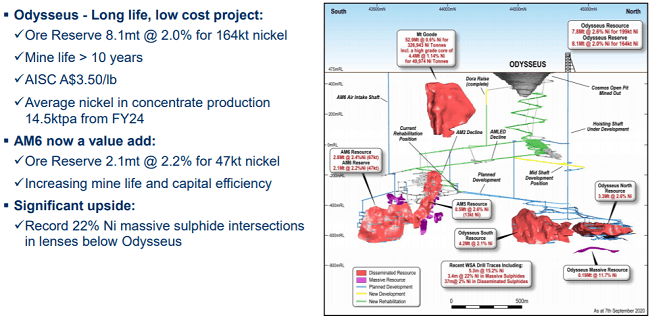
Assuming this all goes ahead as envisaged, production is expected to begin at the site during late 2022, while the average nickel-in-concentrate output should reach 14,500 tonnes in 2024.
With Odysseus, Western Areas is confident it is sitting on a long life (10 year-plus), low cost project.
The ore body’s current reserves are 8.1 million tonnes grading 2 per cent nickel for 164,000 tonnes, with all-in sustainable costs pencilled in at $3.50 per pound.
Since approving the mine plan the company has also added to the project’s inventory with the announcement of a further reserve at AM6, just to the south, of 2.1 million tonnes at 2.2 per cent nickel for 47,000 tonnes.
During last week’s Diggers & Dealers Mining Forum in Kalgoorlie-Boulder, Western Area’s managing director Dan Lougher said pre-production activities had already started on Odysseus’ underground infrastructure, with the resources house expecting to spend $252 million on the development between 2021-23.
Current work includes the drilling of a pilot hole for a proposed hoisting shaft, as well as the completion of optimisation studies for the expanded 900,000t per annum concentrator (which has a present capacity of 550,000t pa).
In terms of the 1.27 million tonnes per annum (ore and waste) shaft – which was being brought in second hand from South Africa – Lougher said its installation would see the mitigation of 85 per cent of carbon dioxide emissions, a drop in the burning of diesel fuel (1.5 million litres pa) as well as the removal of 5 megawatts of heat generated from diesel engines.
Another take-home message regarding Odysseus was the fact it had significant upside, with trace drilling at depth revealing 3.4 metres at a breath-taking 22 per cent nickel in massive sulphides and a further 37m at 2 per cent in disseminated ones.
Lougher suggested the 22 per cent intersection possibly represented the highest mineable nickel intercept in the world, although he welcomed any opinions to the contrary.
A further interesting point raised during Western Areas’ Diggers & Dealers’ presentation was the fact the company is currently celebrating its 20th anniversary, having listed on the ASX in July 2000 on the back of a $5 million IPO with an issue price of 20 cents per share.
While not dwelling too long on this, Lougher did manage to show a group photo of some of the key people who helped turn this junior into the outstanding mining story that it is today.
Missing from this picture, he noted, was the late Terry Grammer, the geologist who – along with Azure Minerals (ASX: AZS) boss Tony Rovira – discovered Cosmos.
A coincidence perhaps, but given this it’s fair to say that while the fortunes of the resources industry may generally be cyclical, the arrival of Odysseus in 2022 will well and truly mark the completion of a full circle in the history of WA’s modern nickel sector.
THE DRILL SERGEANT: Middle Island Resources (ASX: MDI) has taken the Resource inventory for the company’s Sandstone gold project in Western Australia to over 730,000 ounces of gold.
The upgrade comes by way of a maiden Mineral Resource for Sandstone’s new McIntyre satellite open pit deposit, and updated estimates for the existing Twin Shafts and Goat Farm deposits, which have combined to add a further 40,100 ounces of gold.
More than 91 per cent of McIntyre and 84 per cent of Twin Shafts’ estimates are classified in the higher confidence Indicated category, while Goat Farm has been classified as an Inferred Mineral Resource, due to rig access constraints precluding a higher drill density.
McIntyre represents the third of five new satellite open pit deposits measured by Middle Island’s 50,000m drilling campaign undertake in 2020.
All three deposits will now be optimised to determine the in-pit Mineral Resources likely to contribute to Ore Reserves in the current Sandstone feasibility study.
“The maiden Mineral Resource for the McIntyre satellite deposit, and updated Mineral Resources comprising the Twin Shafts and Goat Farm open pit deposits increase the total Sandstone project Mineral Resources to 732,000 ounces gold,” Middle Island Resources managing director Rick Yeates said in the company’s announcement to the Australian Securities Exchange.
“The McIntyre and Twin Shafts deposits will now be optimised and mine designs prepared to determine Ore Reserves likely to contribute to the FS.
“The lower strip ratio anticipated at the McIntyre satellite deposit suggests it may be scheduled for mining and processing earlier in the mine life, making a very valuable contribution to the project.
“Mining of the Twin Shafts southern extension will provide for greater tailings capacity within the existing in-pit licenced storage facility, while a cut-back of the existing Goat Farm open pit will provide for a larger capacity in-pit tailings storage option, beyond the initial open pit production scenario, should it be required.
“Final resource definition samples for the Ridge and McClaren deposits have now been received from the assay laboratory.
“We look forward to compiling and announcing these results shortly, prior to finalising Mineral Resource estimates for these two remaining satellite deposits.”
TO READ THE FULL ANNOUNCEMENT: CLICK HERE
Email: info@middleisland.com.au
