Breaker Resources Extends Tura High-Grade Zone at Bombora

THE DRILL SERGEANT: Breaker Resources (ASX: BRB) reported on recent drilling activity at the company’s Lake Roe gold project east of Kalgoorlie in Western Australia.

Breaker Resources said the drilling at the 1.4 million ounce project had continued to extend high-grade gold mineralisation at relatively shallow depths below the Bombora open pit Resource.

The diamond drilling delivered:

BBDD0129
6.8 metres at 12.07 grams per tonne gold from 277m (estimated true width of 3.4m), including 3m at 21.53g/t gold from 280m.

A step-out hole BBDD0130 was drilled a further 80m to the south that intersected the Tura lode, displaying numerous specks of visible gold with assays pending.

Breaker said these latest results have extended the down-plunge extent of high-grade mineralisation on the Tura lode to 900 metres with the system remaining open down plunge.

“These results provide more strong evidence that the roots of the Bombora ore system have high-grade lodes with genuine underground mining potential,” Breaker Resources managing director Tom Sanders said in the company’s ASX announcement.

“Given what we are seeing in the core, we are eagerly awaiting the assay results from BBDD0130.

“The underground potential is growing rapidly with high-grade lodes opening at scale in several areas directly below the three kilometres-long open pit Resource.

“So far, we have partially defined two of these with the steeply dipping, 900 metres-long Tura lode in the central area, and the 2.2 kilometres-long package of stacked flat lodes to the north.

“There is also the emerging potential of other steeply dipping lodes such as Daisy and Brigalow Mick, and the known potential of the strike-extensive west-dipping lodes like Quarries.”

Drilling at the Lake Roe project is continuing with two diamond drill rigs running continuously, and one Reverse Circulation (RC) rig operating on a campaign basis depending on availability.

The diamond rigs are targeting high-grade lode extensions on 80m step-outs, while the RC rig is primarily focussed on near-surface extensions of the open pit Resource, and on exploratory drilling outside Bombora.

Assay results are pending for seven diamond drill holes targeting the Bombora deposit, and for thirty RC drill holes targeting several areas including the Carbineer prospect; the Windward prospect situated 14km north of Bombora; and the margin of the Swan Lake Syenite to the east of Bombora.


TO READ THE FULL ANNOUNCEMENT: CLICK HERE


Email: breaker@breakerresources.com.au


Web: www.breakerresources.com.au


Westgold Resources Goes Bareknuckle in Gascoyne Resources Takeover Stoush

THE BOURSE WHISPERER: Westgold Resources (ASX: WGX) called out the Board of takeover target Gascoyne Resources (ASX: GCY) in an announcement this morning comparing its offer against that of Firefly Resources (ASX: FFR).

Westgold declared it had received a good deal of incoming positive engagement from shareholders of Gascoyne Resources regarding its intention to make an off-market takeover offer for all the issued shares in Gascoyne.

Westgold’s offer is subject to the Firefly Scheme not proceeding and customary off-market takeover bid conditions including, inter alia, a minimum acceptance condition of 50.1 per cent.

Westgold intends to lodge its Bidders Statement with ASIC during the week commencing 10 October 2021.

“It has been more than a week since Westgold announced its intention to make a bid on terms that are far superior to Gascoyne’s proposed merger with Firefly,” Westgold Resources executive director Wayne Bramwell said in the company’s ASX announcement.

“Bemusingly, the Gascoyne Board has provided no guidance to Gascoyne’s shareholders nor to Westgold regarding the Board’s intentions on either the Firefly Scheme or the Westgold Offer.

“The silence from the Gascoyne Board in relation to our Offer is in stark contrast with the volume of calls and emails we are receiving from Gascoyne shareholders wanting our Offer to be considered by their Board.

“Westgold knows the Gascoyne Board is cognisant of its fiduciary duty to its shareholders and would expect the Board to dutifully and proactively act to ensure their loyal shareholders have the opportunity to evaluate and respond to our value accretive proposition.”

The company compared the details of each offer, saying that “Based on the Independent Expert’s Report contained in the Firefly Scheme booklet”, should the Firefly Scheme taken up the value would equate to 18.3 cents per Gascoyne share.

The Westgold Offer of one Westgold share for every four Gascoyne Shares implies a value of 44 cents per Gascoyne share.

The gloves were then removed:

“The Gascoyne Board must act in accordance with its fiduciary duties to its shareholders and take all steps necessary to terminate the inferior proposed Firefly Scheme,” the company stated rather firmly.

“At the very least, Westgold considers that the Gascoyne Board must postpone the proposed Firefly Scheme meeting to allow its shareholders the opportunity to consider the merits of the Westgold Offer, as compared to the dilutive Firefly Scheme.

“The Firefly Scheme structure denies Gascoyne shareholders any vote or choice on this value destructive transaction.

“Westgold considers that once given the choice, a Gascoyne shareholder’s acceptance of the Westgold Offer is in effect also a vote against the Firefly Scheme.

“Westgold encourages Gascoyne shareholders to demand that its Board act in its shareholder’s best interests and provide an opportunity for Gascoyne shareholders to consider and accept the Westgold Offer.

“Westgold is committed to ensuring that Gascoyne shareholders are provided an opportunity to consider and accept the compelling Westgold Offer and has appointed an advisory team of Argonaut PCF and HopgoodGanim Lawyers to assist with the preparation of our Offer.”


At the time of publication neither Gascoyne Resources or Firefly Resources had released responding statements.


TO READ THE FULL ANNOUNCEMENT: CLICK HERE


Email: perth.reception@westgold.com.au


Web: www.westgold.com.au


Johann Jacob King Island Scheelite (ASX: KIS) October 2021

King Island Scheelite (AX: KIS) just raised $31M to develop the company’s Dolphin tungsten mine on King Island off Tasmania. KIS executive chairman Johann Jacob zoomed into The Resources Roadhouse to tell Wally Graham how the company raised the cash and how they intend to spend it.

Miramar Resources Reports Strong Gold Hits at Gidji

THE DRILL SERGEANT: Miramar Resources (ASX: M2R) reported new aircore drilling results from the company’s 80 per cent-owned Gidji JV project in the Eastern Goldfields region of Western Australia.

Miramar Resources said the new results had resulted from aircore holes drilled at the Marylebone, Railway, Piccadilly and 8-Mile targets and have continued to reinforce the potential for one or more new gold discoveries at Gidji.

The company has determined the Marylebone target comprises at least four parallel zones of coherent aircore gold mineralisation, stretching over almost two kilometres of strike, which are related to contacts between mafic and ultramafic rocks like the Paddington and Panglo deposits along strike to the northwest.

The recent drilling outlined a new zone of gold anomalism greater than 0.25 grams per tonne gold, west of previous drilling, which is at least 1km long returning a result at its northern end of:

GJAC426
6 metres at 1.23 grams per tonne gold.

New drilling within the central target zone included two holes drilled either side of earlier holes that did not reach basement.

The new holes encountered:

GJAC428
1m at 2.63g/t gold; and

GJAC429
5m at 1.21g/t gold.

Both new holes encountered high-grade gold in weathered basement directly beneath the unconformity with the transported material.

“Marylebone continues to deliver significant aircore results from each program, which increases our confidence that there could be a significant new gold discovery to be outlined,” Miramar Resources executive chairman Allan Kelly said in the company’s ASX announcement.

“After four aircore programs of relatively wide-spaced holes, we still have not yet determined the full extent of the Marylebone footprint, which is currently about two kilometres long, and still growing.

“In addition, even though our focus has been mostly on defining the extents of the Marylebone target, we have also continued to test other targets that add to the developing opportunity at Gidji.”

Miramar has interpreted the recent results to show the Marylebone target now apparently closed off at the south-eastern end but remains open along strike to the northwest onto the company’s recently granted tenement applications.

Miramar plans to extend its aircore drill coverage to the northwest, as well as conducting selected infill holes, with plans to complete this drilling by the end of 2021.

The aim of the next aircore drilling campaign will be to refine targets for RC drill testing in early 2022.


TO READ THE FULL ANNOUNCEMENT: CLICK HERE


Email: info@miramarresources.com.au


Web: www.miramarresources.com.au


Kin Mining Denies St Barbara Before Launching Fund Raiser

THE BOURSE WHISPERER: Kin Mining (ASX: KIN) has shaken off a takeover offer to launch a $13 million raising to progress the next phase of exploration at the company’s 100 per cent-owned Cardinia Gold Project (CGP) near Leonora in Western Australia.

Kin Minin revealed it had been subjected to a clandestine non-binding indicative offer (NBIO) from St Barbara (ASX: SBM).

The suitor company had offered to acquire 100 per cent of Kin shares via a Scheme of Arrangement at an implied price of 16 cents per share that was subsequently rejected by Kin Board, which believed the NBIO would not have been approved by the requisite 75 per cent voting majority of Kin’s shareholders.

The NBIO was highly confidential, secret squirrel stuff, being subject to a number of conditions, including no leak or public disclosure of the NBIO, due diligence, the unanimous recommendation of the Kin Board, the execution of a scheme implementation agreement between SBM and Kin containing exclusivity mechanisms, and no further issuance of equity securities by Kin.

“The Kin Board welcomed the continued interest from St Barbara noting that the proposed NBIO price suggests that the current Kin share price is significantly undervalued,” Kin Mining managing director Andrew Munckton said in the company’s ASX announcement.

“The Kin Board remains focussed on progressing company activities to maximise the value of the company for all shareholders.”

With the St Barbara dust settled, Kin Mining announced its intention to launch an Entitlement Offer, which will be available to all eligible shareholders that will be priced based on recent share trading.

The company indicated the funds raised will provide sufficient working capital to complete the next phase of systematic exploration work at the CGP and to follow up on the new discoveries and targets identified as part of its recent drilling campaigns completed during 2020 and 2021.

These include the emerging discoveries at Mt Flora and Iron King, as well as multiple new prospects which have been identified following t improvements in the company’s understanding of the geology and potential of the CGP such as the Eagle and Crow prospects.

“We’ve had considerable success converting our improving geological understanding into exploration results, and then converting those results into additional Mineral Resources,” Munckton said

“At Cardinia Hill, we have successfully added 106,000 ounces of new Mineral Resources, while the Bruno-Lewis Mineral Resource has been expanded by 20 per cent to 374,000 ounces.

“Our systematic approach to exploration has paid off in spades and given us a much better idea of where and how to target the next phase of drilling – which will be designed both to define new resources and to identify additional discoveries with the potential to deliver a step-change in the value of the project.

“The additional funding will allow us to continue to assess the recent discoveries at Cardinia Hill and follow up on new prospects like Mt Flora, Eagle and Crow – in short to maintain the very strong exploration momentum we have built up over the past two years.

“Other targets across the land package have been identified by recent soil geochemistry and modern geophysical surveys over largely untested areas within the highly mineralised Cardinia area.

“We expect this work to generate new follow-up programs of work stretching into 2022.”


TO READ THE FULL ANNOUNCEMENT: CLICK HERE


Email: info@kinmining.com.au


Web: www.kinmining.com.au


Rox Resources Improves Youanmi Deeps Gold Extraction

THE DRILL SERGEANT: Rox Resources (ASX: RXL) with Joint Venture partner Venus Metals Corporation (ASX: VMC) reported on recent metallurgical testwork conducted on the Youanmi Deeps Resource, located within the OYG JV area (Rox 70% and Manager, VMC 30%) in Western Australia.

The JV is undertaking development studies into potential future production at the Youanmi gold project.

The recent work is a preliminary part of the study to establish processing pathways to optimise gold recovery prior to progressing to more extensive and detailed ‘feasibility study level’ metallurgical testwork.

Rox reported that the testwork demonstrated a well understood pathway to very high gold recoveries, something which was not achieved in the 1990s.

Historical production at the mine averaged 86.8 per cent gold recovery, with new testwork improving extraction to 95.6 per cent.

Further testwork in combination with the costing studies is expected to determine the optimal and most economical feasible process solution, exploring various other suitable processes.

“In June 2021 we reported a 30 per cent increase in the Youanmi Deeps Resource, and now we are pleased to report that advances in gold extraction technology over the last 30 years (since GMA built its processing plant) have made a significant difference in gold recovery,” Rox Resources managing director Alex Passmore said in the company’s ASX announcement.

“Preliminary metallurgical testwork indicates a 10 per cent increase on historical gold recoveries by utilising a pressure oxidation leach process (i.e. POX).

“Furthermore, we look forward to results of (scoping level) process plant design and costing later this year being undertaken by Como Engineers who have a long track record of success for both design and development of similar sized gold processing facilities in WA with a variety of flowsheet designs.”


TO READ THE FULL ANNOUNCEMENT: CLICK HERE


Email: admin@roxresources.com.au


Web: www.roxresources.com.au


Nickel Bulls Pump Bandwagon Tyres

THE CONFERENCE CALLER: Opening Paydirt’s Australian Nickel Conference in Perth this week, Wood MacKenzie principal analyst, nickel Angela Durrant was bullish on the outlook for the forum’s featured metal.

With a full house in for the opening session, Durrant opened on fairly safe ground, acknowledging what most in attendance already knew, that being that nickel prices are currently enjoying a runin the sun thanks to the current global energy transition, which for nickel has meant ever increasing interest in the electric vehicle (EV) supply chain and production of nickel sulphate to feed EV batteries.

She provided a look at price data the boffins at Wood MacKenzie have accumulated over the past 18 months for metals that are part of the energy transition story, namely copper, cobalt, aluminium and nickel, which demonstrate how all have climbed significantly from March 2020 through to September this year.

“For nickel, in particular, after recording a low of US$11,055 on March 23 2020, prices increase steadily for the next 12 months,” Durrant said.

“If we consider nickel consumption by first use, stainless remains the market’s main consumer, currently accounting for around 70 per cent of total consumption.

“However, looking out to 2040, this share drops to 53 per cent as battery precursors for EVs and energy storage become increasingly more important.”

Battery precursors for electric vehicles currently account for just seven per cent of global nickel consumption, but by 2040 it is expected this share will have climbed to 30 per cent.

Wood MacKenzie is well on board the nickel bandwagon, with Durrant reporting for the next 20-years the firm is forecasting nickel consumption to more than double from 2.4 million tonnes in 2020 to 4.9 million tonnes in 2040.

This includes stats for nickel consumed in stainless, which Wood MacKenzie expects to hit 2.5 million tonnes in 2040 compared to 1.7 million tonnes in 2020 and nickel consumed in battery precursors reaching 1.5 million tonnes, compared with only 177,000 tonnes in 2020.

“The bottom line is that we are anticipating solid growth in demand for battery precursors above all other first-use sectors,” Durrant said.

“This view is supported by projections for electric vehicle car sales over the same 20-year period.

“We currently forecast annual sales for passenger EVs to exceed 49 million in 2040, compared to around three million in 2021 and two million in 2020.”

Not all batteries are the same and their chemical make ups differ to the point where some will maintain favour, while others will fall off the pace.

The current dominance of nickel, manganese, cobalt (NMC) batteries of the 532 and 662 variety is thought to be challenged by high-nickel 811 types by 2025.

The NMC 811 and the LFP (lithium-ion phosphate) battery types, will provide the majority of required gigawatt hours for EV batteries from 2030 onwards.

“In the next 10 years or so, it is quite possible that other configurations may find favour, but in terms of what is commercially applied right now, this is how we see the market developing,” Durrant said.

“In terms of nickel, the progressive dominance of 811 will boost consumption, but this will be countered by lower intensity of use as battery pack size gets smaller due to increasing energy density.”

Possibly one of the least surprising statements Durrant delivered during her address was that future demand for battery precursors, or sulphate, on a regional basis, would see China taking the main podium as the main consumer in the years to 2030.

“In 2021, we estimate China’s demand will total 211,000 tonnes of nickel in precursor and will increase to almost 700,000 tonnes in 2030, Durrant explained.

“In terms of supply, nickel sulphate for use in EVs will be the largest consuming sector, accounting for over 900,000 tonnes of nickel by 2030.

“Coming back to this year, we expect that nickel in sulphate production will actually start to exceed demand and that this will continue until 2025.

“This is the point, in 2025, where there will be a need for new investment in sulphate capacity.

“Our current outlook for the short-term nickel market is one of tightness.”

Despite the number of nickel miners, potential miners and explorers in the room, Durrant raised the important part to be played in the future prospects of the metal by the recycling industry.

“Given the consecutive deficits…that we are forecasting over the latter half of the decade, we expect that recycling will also become increasingly important for nickel,” she said.

“In fact, we could be so bold as to suggest the future nickel supply could be a redirection of investment funds to recycling.

“The inherent qualities of recycling make it attractive – a potential lower environmental footprint combined with the social message of moving, what is hitherto, being material going into landfill.”

Market watchers will already be aware of the companies already breaking ground in this field that are rapidly establishing themselves by collecting and processing spent batteries or through the manufacture of reusable products.

Although differences exist between the different players, most share a commonality in their small company size, and typically producing less than 10,000 tonnes of nickel in black mass, or sulphate, but potential exists for scaling up these efforts.

An important emerging factor noted by Durrant is the growing concern producers and consumers alike have with ESG in carbon dioxide emissions and the knock-on effect this has on production.

She stressed the need to produce clean, green, sustainably resourced nickel has become increasingly important and with this in mind, Wood MacKenzie has developed an emissions benchmarking tool.

“The Carbon Emissions Intensity Tool illustrates that nickel pig iron (NPI) producers in Indonesia high on the emissions curve, largely due to the intensive use of coal for power generation,” she said.

“Large integrated sulphide producers, however, sit much lower down on the curve.

“Not to disappoint, in Australia most producers, both sulphide and laterite, are closer to the lower end of the CO2 emissions curve and sit well below the weighted annual average, which I’m sure you will all be happy to know.

“These positions will become increasingly important as consumers and investors look to the source of the nickel supplying their electric vehicle batteries and their energy storage requirements of the future.”

Looking at current market fundamentals, Wood MacKenzie has determined the global nickel deficits running through to 2030 will support annual average prices approaching US$19444 per tonne by 2026, followed by even higher prices of around US$21000 through to 2029.

This could see four straight years of metal inventory drawdowns that will drastically shrink global stocks towards 100 days of consumption around 2031, a level not seen since 2005 when prices also averaged US$19980 per tonne.
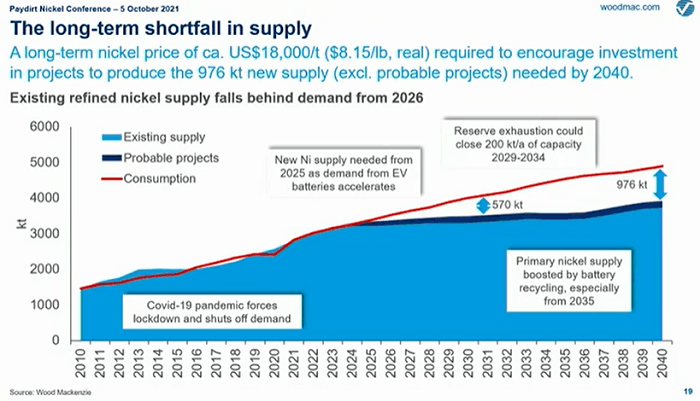
“By 2026, the market will need to find new nickel, either from our extensive list of probable projects, or possible projects as well, or from elsewhere,” Durrant said.

“By 2031, the requirement for nickel from these sources is estimated to be around 570,000 tonnes…which will expand to 976,000 tonnes by 2040.

“I think worth pointing out, at this juncture, that nickel prices currently sit around US$18,000 to US$19,000 per tonne

“Even at that level, we are not seeing banks putting their hands in their pockets to finance new projects, which signals there is still much caution despite the optimism around EVs and nickel consumption growth.”


Trigg Mining Releases Scoping Study for Lake Throssell Sulphate of Potash Project

THE DRILL SERGEANT: Trigg Mining (ASX: TMG) released results of a Scoping Study completed on the company’s 100 per cent-owned Lake Throssell Sulphate of Potash (SOP) project located in the Eastern Goldfields of Western Australia.

Trigg Mining explained the Study was underpinned by the upgrade of a portion of the total drainable Mineral Resource to the Indicated category.

A total drainable Indicated Mineral Resource estimate of 4.2 million tonnes of SOP at 4,770mg/L potassium (or 10.6kg/m3 K2SO4) has taken the total drainable Mineral Resource to 14.4 million tonnes at 4,665mg/L potassium (or 10.4 kg/m3 K2SO4).

The company informed the market that the Scoping Study results have confirmed the potential for the Lake Throssell SOP project to be a low-cost, long-life producer of natural sulphate of potash for food production.

Source: Company announcement.

“The completion of a Scoping Study is a huge milestone for the Trigg team, for our shareholders and for those who have supported us since we listed on the two years ago,” Trigg Mining managing director Keren Paterson said in the company’s ASX announcement.

“The Scoping Study outcomes strongly vindicate our long-held belief that Lake Throssell is a potential company-maker – a high-quality, long-life asset which can transform Trigg into a modern, sustainable Australian SOP producer with a Top 10 globally competitive project.

“The key attributes of the project are clearly highlighted in this Study – the scale and quality of the Resource, its Tier-1 location, proximity to infrastructure and ability to support a multi-decade operation which can also deliver a number of exceptional ESG outcomes.

“Apart from the social and economic benefits it will provide, the project utilises solar evaporation to produce a natural fertiliser essential for global food security.

“This is a defining moment for Trigg and provides investors with a clear picture of the economic potential of Lake Throssell as a long-life, low-cost project that can ultimately provide dividends to shareholders.

“Our methodical and focused approach to developing the project will continue as we leverage the key learnings from the new potash industry currently being developed in Western Australia.

“We are very excited about the opportunities in front of us and we are looking forward to progressing the Project to the next stage with a Pre-Feasibility Study.”


TO READ THE FULL ANNOUNCEMENT: CLICK HERE


Email: info@triggmining.com.au


Web: www.triggmining.com.au


AuTECO Minerals Encounters New Pickle Crow Gold Zone

THE DRILL SERGEANT: AuTECO Minerals (AUT: ASX) claimed the making of a high-grade gold discovery at the company’s Pickle Crow gold project in Canada.

AuTECO Minerals reported the Tyson discovery, saying the vein system consists of at least three persistent quartz-carbonate-scheelite-gold veins.

Mineralisation within the vein structures has been encountered over an interpreted strike of approx. 400 metres and at depths exceeding 800m below surface.

Recent drilling intersections include:

AUDD0173
2.8 metres at 17.9 grams per tonne gold from 578.3m;

AUDD0152
1m at 30.1g/t gold from 546m;

AUDD0173
5.5m at 4.1g/t gold from 566.5m; and

AUDD0166 W1
1.1m at 10.4 g/t gold from 665.05m.

AuTECO stressed the Tyson veins are outside of the Inferred Resource the company had recently reported of 1.7 million ounces at 8.1 grams per tonne gold and demonstrate the potential to continue to grow the Resource with focused and systematic exploration.

“The discovery of another significant vein system demonstrates yet again the exceptional quality and the immense potential which still remains at Pickle Crow,” AuTECO Minerals executive chairman Ray Shorrocks said in the company’s ASX announcement.

“This discovery also provides more evidence of how under-explored Pickle Crow is and in particular, the lack of modern exploration conducted there.

“We will continue drilling at Tyson to extend the known mineralisation and also infill drill it with the aim of bringing it into the Resource.

“With a fifth rig arriving within the next month, we are on track to deliver the current 50,000 metres drill program on budget and on schedule.”


TO READ THE FULL ANNOUNCEMENT: CLICK HERE


Email: info@autecominerals.com


Web: www.autecominerals.com


Alto Metals Claims New Juno Gold Discovery

THE DRILL SERGEANT: Alto Metals (ASX: AME) claimed a new gold discovery from recent RC and Diamond drilling at the company’s 100 per cent-owned Sandstone gold project in Western Australia.

Alto Metals announced the discovery of the Juno gold zone, as well as reporting further thick, high-grade gold assay results from RC drilling below the Lord Nelson pit, as part of the recently program.

Lord Nelson is hosted at the northern tip of a large granodiorite intrusion, that is more than three kilometres long and up to 600 metres wide and has had limited drilling below 100m depth.

The new Juno discovery, described as an, “undiscovered extension of the new mineralised zone”, below Lord Nelson pit was identified via RC drilling along the southern extent of the Lords Corridor, up to 600m south of the Lord Nelson pit.

Assay results from the Juno discovery, include:

SRC443
13 metres at 5.1 grams per tonne gold from 162m, including 3m at 17g/t gold from 168m;

SRC444
23m at 1.7g/t gold from 141m, including 5m at 5.4g/t gold from 154m; and

SRC449
22m at 1.6g/t gold from 135m, including 5m at 5.5g/t gold from 152m.

“The results from the new Juno lode are outstanding, with high-grade mineralisation intersected further along the Lords corridor, and clearly demonstrates the potential for further growth,” Alto Metals managing director Matthew Bowles said in the company’s ASX announcement.

“Juno is considered a previously undiscovered extension of the mineralised zone below the Lord Nelson pit, outside the current resource, which currently extends for over a kilometre strike and remains open.

“At the same time, we have also hit further thick, high-grade mineralisation from deeper drilling beneath the Lord Nelson pit, with SRC432 returning 45m at 3.2g/t gold, including 5m at 17.5g/t gold, which was drilled approximately 30m north SRC423 and returned 48m at 3.4g/t gold, demonstrating the continuity of mineralisation, outside the current resource.

“The nature and style of mineralisation that we see at the Lord’s granodiorite, with gold mineralisation within the granodiorite ‘damage zone’ and high-grade gold along the margin of the ultramafic contact, is very similar to that of the Tarmoola granodiorite at Red 5’s King of the Hills.

“This is very encouraging as it highlights the scale of what we potentially may have at the Lords Corridor.”


TO READ THE FULL ANNOUNCEMENT: CLICK HERE


Email: admin@altometals.com.au


Web: www.altometals.com.au