


Norman Moore prepares for well earned retirement
THE CONFERENCE CALLER: Due to retire at the upcoming state election, Norman Moore stopped by the RIU Explorers Conference to say farewell.
Since he regained his job as Western Australian Minister for Mines and Petroleum following the election of the Barnett Government four years ago, Norman Moore has been a familiar, and much welcomed face at all mining industry events.
Moore took over the portfolio at a difficult time with the Global Financial Crisis just letting the world know it had arrived.
It was a time that saw a great deal of turmoil across the resources sector with much pain being felt mostly in the exploration sector, the sector that normally feels the most pain in such economic circumstances.
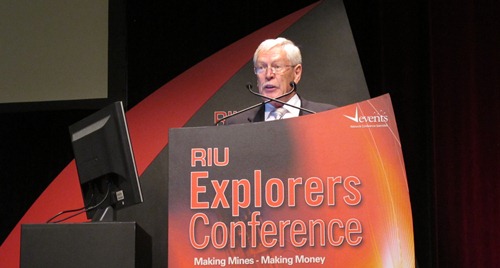
“Clearly, the State government at the time couldn’t do anything to change the global economic outlook, but what we could do was reduce the risk associated with exploration by streamlining the processes of getting approvals in the system,” Moore told the audience at the RIU Explorers Conference in Fremantle.
Moore’s brief was to encourage the long term growth of the Western Australian resources sector and to help it maintain its standing as, what he described as being, “the backbone of the Nation’s economy”.
Moore rolled out a number of impressive statistics that demonstrated how affective his recent Ministership has been.
2011-2012 financial year statistics show Western Australian resources recorded sales of $106 billion.
Iron ore remained the state’s most valuable sector accounting for $61.1 billion with petroleum contributing around $23.8 billion
Exploration expenditure during 2011-2012 increased to an all-time record of $2.1 billion, which represented a 32 per cent increase on 2010-2011.
Exploration expenditure for iron ore was the largest figure accounting for 46 per cent spending $1.2 billion representing a 75 per cent increase from 2010-2011.
Overall Western Australia accounted for 53 per cent of all the mineral exploration in Australia, almost doubling its closest rival Queensland.
“These are pretty impressive figures and I think there are a testament to the prospectively of Western Australia and the confidence the industry has in the Western Australian economy and our resources industry,” Moore said.
“I think it’s fair to say that I’m not inflating expectations when I say Western Australia is the place to come when you want to invest, explore, or indeed, to mine.
“It is a very desirable destination.”
Moore put the responsibility for the results on the implementation of a number of new initiatives by the WA government and the state’s mining industry.
When the government was elected the first thing it did was to re-establish the Department responsible for mining and petroleum as a standalone agency creating the Department for Mining and Petroleum (DMP).
A second initiative was the introduction of the Exploration Incentive Scheme (EIS).
There are six programs in the exploration incentive scheme with the best known of these being the co-funded exploration drilling program, which refunds up to 50 per cent of successful candidates’ drilling costs.
Since the program began in 2009, more than $30 million has been offered to some 315 projects across the six funding rounds in the state. Round seven of the co-funded drilling round will open next week.
The EIS also provides additional geological support to the industry, and has flown more than 2.7 million line kilometres of airborne magnetic and radiometric data in the past four years, completing the coverage of the entire state at 400 metres, or less, line spacing.
“This program is the biggest geophysics data campaign exercise ever undertaken in Australia,” Moore boasted.
If a good example of the success of the EIS is needed then you don’t really have to look much further than Sirius Resources, which successfully used three aspects of the scheme to find the Nova deposit.
The company utilised regional geochemical sampling together with airborne magnetics to identify and area of interest around a geological anomaly.
Sirius then obtained co-funding for a deep hole and subsequent drilling discovered the much talked about Nova deposit.
Probably the most important initiative Moore has been able to introduce is the improvement to the approvals process in Western Australia.
“It simply was taking too long to get approvals,” he said.
“As a result of some hard work and good initiatives the average mine approval process in Western Australia now has been reduced to around 28 months – still too long, but when I first got here it was taking up to three year in many cases.
“In 2012 the Department finalised 82 per cent of its 7,048 mining, petroleum and geothermal applications within the targeted time frames.”
Moore also talked up the potential importance of the recently-ratified Reforming Environmental Regulations Strategy (RER).
“One particular area of the RER that is important to me has been the development of the new Mining Rehabilitation Fund,” he said.
“This fund is set to require most operators to start paying a levee by July next year and this will ensure tax payers are not footing the bill for abandoned mine site rehabilitation work.
“However, it also means companies will no longer be required to take out environmental bonds.”
In closing Moore reiterated the importance of exploration to the continued vitality of the mining industry.
“You have to find the mines of tomorrow today otherwise the industry has no future,” he said.
“So it is absolutely vital that we get exploration continuing in Western Australia and that new ore bodies are found on a regular basis.
“It’s been a pleasure to have worked with you over the years and I wish you all great exploration success in the years to come.”