


MRRT passage sidelines lack of exploration spend
PETER HAYES: The Minerals Resource Rent Tax was given its final passage through the Australian Senate earlier this week, and the market reacted by generally taking it all in its stride.
Apart from long-term anti-tax advocate Andrew ‘Twiggy’ Forrest’s Fortescue Metals Group that is, which commenced a High Court challenge to the Legislation, arguing the new tax was unconstitutional.
The rest of the market however, particularly at the speculative end, just continued on in the scatterbrain way the Australian Securities Exchange has been trading of late.
Some stocks are killing it, while most are not. It’s a tough market, because the losers are way outperforming the winners.
The MRRT has basically made speculative stocks with Australian projects less sought after.
“The tax is simply unfair to smaller emerging miners, and is so complex that the administrative and compliance burden on industry and government will be extreme,” Association of Mining and Exploration Companies chief executive officer Simon Bennison said in an announcement pre-empting the passing of the MRRT.
“Expert independent modelling undertaken by the University of Western Australia confirmed small and emerging miners will be paying a higher effective tax rate (includes income tax, royalties and the MRRT) than the large mature miners.
“The differential could be as much as four per cent.
“The Australian Government has also not recognised the damage the MRRT will cause to our Nation’s future, and the mines of tomorrow.”
It’s not just that Julia Gillard and Wayne Swan have finally been able to get their MRRT legislation through, however; another factor to throw into the mix is the fact exploration is a mature industry in Australia.
There are definitely more discoveries out there, but smaller companies are finding they get better value for their money in Africa, South Asia, Mongolia or South America.
The fact is a lot of these areas have been under-explored because of domestic issues, lack of capital, and/or a lack of willpower.
With the fact Australia-focused companies now have to deal with more red tape, are working up ground that has usually been subjected to previous heavy exploration, and have an unsympathetic government; at least it seems like it.
While all this is providing a lot of angst amongst Australia-focused exploration plays, the other parts of the world are quickly becoming more and more attractive to prospective junior mining companies.
Also, Australian companies come with generally experienced operators, some being experienced at exploration, some being experienced at “promotion”.
Nonetheless, the Aussie companies do come with capital, and that is sorely needed in a lot of these emerging areas.
Recent statistics have helped to show just how much Australia is lagging in exploration expenditure.
It seems that it is the big oil and gas companies and multinationals are spending the money, not the junior sector.
Australian Bureau of Statistics data estimated the trend for total mineral exploration expenditure rose 2.9 per cent or $26.6 million to $944.7 million in the December quarter 2011, while the seasonally adjusted estimate rose 2.4 per cent or $22.1 million to $946.7 million in the December quarter 2011.
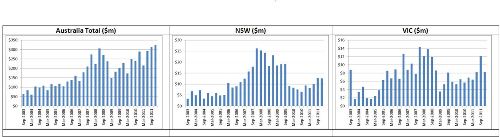
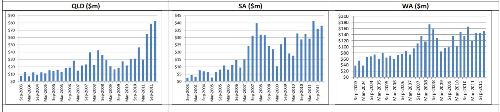
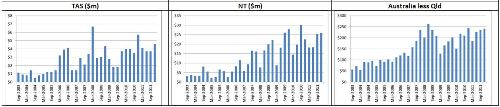
Source: Australian Bureau of Statistics
Simon Bennison believes these figures should be no cause for celebration.
“This headline expenditure figure does not tell the full story about the health of Australia’s exploration industry,” he told MiningNews.net.
Bennison said a better indicator of the health of Australia’s exploration industry was metres drilled, which had decreased for both brownfield and greenfield exploration over the quarter.
ABS data showed total metres drilled fell 6.4 per cent while drilling in areas of new deposits fell 2.9 per cent and drilling in areas of existing deposits fell 8.2 per cent.
Bennison said greenfields share of total metres drilled fell from around 45 per cent in 2003 to just over 30 per cent while exploration drilling of brownfields had risen from 55 per cent to 70 per cent.
New discoveries are being drilled in the Philippines, Somalia, Peru, and at a number of other new areas.
Greenfields are no longer in Australia generally, and most Australian companies are raising money through Australian taxpayers to explore in other countries.
Basically, a lot of the money is going offshore.