


ABM finishes sampling Old Pirate
THE BOURSE WHISPERER: ABM Resources has completed the final, Phase 4 of a Bulk Sampling and Trenching program at the company’s Old Pirate gold prospect, which is part of its Twin Bonanza gold camp project located on the Northern territory side of the border with Western Australia.
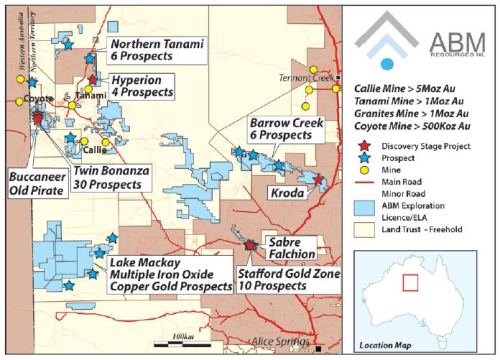
ABM project location map Northern Territory. Source: Company announcement
According to ABM the Phase 4 results averaged 24.70 grams per tonne gold over a combined vein strike length of 144 metres (118 samples) with a peak value of 320grams per tonne gold.
From the total of 118 samples, 30 graded greater than 10g/t gold with an average of 88.15g/t gold.
Nine samples graded greater than 100g/t gold with an average of 187.55g/t gold.
Individual higher grade vein lengths included:
– 102m strike length vein exposed with average width of 1.1m and average grade of 32.62g/t gold including a higher grade vein portion of 18m strike length averaging 104.9g/t gold.
Combined results from Phase 1, 2, 3 and 4 of the Old Pirate Bulk Sampling and trenching included:
– 726m of combined strike length averaging 24.01g/t gold; and
– 799.4 square metres of total vein area exposed with veins up to 6m width, averaging 1.1m width.
“These results from the Old Pirate sampling program have once again extended the system with some spectacular grades,” ABM Resources managing director Darren Holden said in the company’s announcement to the Australian Securities Exchange.
“It is remarkable to think that these veins are outcropping at surface or just below the shallow soil profile and, in places, are running in excess of 100 grams per tonne gold.
“This sampling program has proven extremely valuable in providing quality spatial and statistical information relating to the distribution of gold at Old Pirate.
“The Western Limb Lodes exposed in Phase 4 extend to the north and head under shallow soil cover.
“Overall the gold anomalism at Old Pirate extends over a four kilometre long trend and the possibility of uncovering further veins with detailed exploration work remains a distinct possibility.”