


Bruce Franzen – Riedel Resources
ONE OFF THE WOOD: A portfolio encompassing prospective tenements in Western Australia and Burkina Faso gives Riedel Resources executive director Bruce Franzen plenty to talk about and he perched on a stool in the front bar this week to do just that.
Riedel has a portfolio consisting of projects in Western Australia and Burkina Faso. Which of these is winning to be the company’s major focus at the moment?
We listed about 15 months ago on the back of the suite of projects we acquired in Western Australia.
The main project and focus of all of our recent exploration activities is a gold and base metal project called Marymia.
It comprises of two tenements of approximately 430 square kilometres situated in the Doolgunna-Thaduna trend about 150 kilometres northeast of Meekatharra.
These tenements are part of a cluster of exploration activity within a 10 kilometre radius which includes explorers Ventnor Resources, Sipa Resources, and Lodestar Minerals.
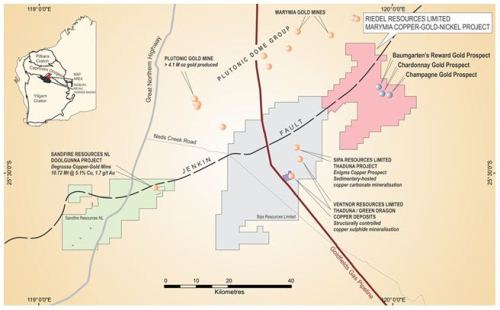
We’ve been on the ground at Marymia since October last year and have recently completed soil sampling and detailed mapping over the entire 431 square kilometres.
We are presently finalising heritage surveys with the view to commencing a 5,000 metre air core drilling campaign to test high priority targets as soon as we can.
There certainly seems to be a lot of drill rig traffic heading up that way these days?
Everybody in the area is either drilling or planning to drill and subsequently news flow from all players is ongoing.
The area is evolving rapidly by virtue of the substantial exploration spend that is occurring.
This means that the area is financeable and consequently funding is being made available.
What did the soil sampling tell you?
We have recently published the geochemical results in regard to gold and this has produced a number of high priority drill targets – some of which are based on strong arsenic anomalies that are coincident with geophysical anomalies and mapping data.
We will be following up those high order gold targets in our upcoming drill program.
When will that drilling commence?
Final heritage clearance is commencing Monday, next week, so we expect to be able to commence drilling within a few weeks.
We concede, as is typical of this process, that we have been subjected to delays in the heritage clearance process which is nothing short of frustrating. Anyway, that’s what we are aiming for.
What’s happening with the copper geochemical results from Marymia?
The copper and base metals data is still being standardised and interpreted; however we expect results to be ready for release to the market within the next few weeks.
Is this the first time these tenements have seen any exploration?
There has been historical work at Marymia over the last 30 years, including RC and RAB drilling and some limited diamond drilling.
When we acquired the project, we had 20 years’ plus worth of data to reinterpret and that had been focused primarily on gold with a small amount of work looking at nickel.
We have been able to revisit all of the historical work and apply new technology and ideas, particularly in the area of geophysics which has changed immensely. This has given us a vastly different outlook for Marymia compared to past explorers.
Earlier exploration technologies didn’t have the same resolution that we have today, for example some of the structural controls that we now understand to be important at Marymia were simply not understood previously.
The gold price is also far superior these days which is stimulating significant focus for us on gold as well as copper.
What have you been able to identify that hadn’t been before?
We have come up with a stand out gold target that is represented by a seven kilometre arsenic halo coincident with a significant structure, which hasn’t been drilled or previously prospected at all.
It is sitting under cover which explains why in the past it was overlooked. We have demonstrated a distinct correlation between arsenic and gold mineralisation elsewhere in the tenement area where primary veins are exposed at or near surface.
This is a massive target, potentially, which is untested and we plan to test that in our next round of drilling. The team is currently in the field completing infill geochemical sampling over this anomaly to better define the key target area.
You recently added to your project portfolio by picking up some ground in Burkina Faso. What’s the story there?
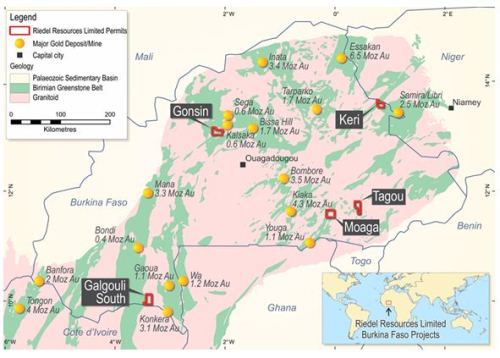
We recently completed a transaction to acquire the rights over five gold permits in Burkina Faso from Golden Rim Resources.
Within 24 hours of completing that transaction we had guys on the plane and within seven days we had commenced an auger drilling program on the Gonsin permit.
You didn’t waste any time there, did you?
Burkina Faso has a pro-mining culture and as a developing country competing for foreign investment, has substantially less bureaucracy and impediments to gaining approvals for field exploration activities.
That meant we were able to move very rapidly without being hampered by onerous bureaucracy, it was absolutely refreshing.
As far as costs go, Burkina provides excellent value for your exploration dollar and they are very accommodating to encourage foreign companies to establish business there.
There are a lot of explorers in the country now, including a number of Australian companies as well as others from Canada and UK.
There does seem to be a particular buzz emanating from that part of the world at present but there are also Burkina-sceptics emerging saying perhaps its gold race has been run?
It’s not a case of there not being any gold there. The question is how much gold is there? That is the reality.
With only about five years of exploration completed to date in Burkina, we believe that it offers explorers staggering potential and could even look like Western Australia 100 years ago.
It is evolving rapidly and there are opportunities being created for everyone. We don’t see this changing in a hurry.
You were on the ground nice and quickly after its acquisition. What has that work led you to so far?
Right now we have a 5,000 metre auger drilling program underway that we expect to be completed within the next week or so. We expect results will start to flow in about six weeks.
Concurrently we have started soil sampling and trenching programs across two of the other permits in Tagou and Galgouli South.
So we are very active on the ground now in Burkina and, subject to the weather not closing in on us, which is the real risk, possibly by mid-July, we hope to have completed 2,000 metres of RC drilling planned on our Tagou permit as well.
Tagou is becoming increasingly prospective for us, in the sense that we are just 30 kilometres north of Mt Isa Metals’ new Nabanga discovery.
Their results this year have really changed the game in Burkina and shown that there are high-grade deposits in the country as well as the more typical large tonnage–lower grade deposits. This has come about by simply applying modern exploration methods to the right geology.
The artisanal miners have also proved that they can adeptly read ASX announcements and we have found a swelling population at Tagou keen to benefit from proximal structures to Nabanga to the south.
It is our intention to work collaboratively with the local artisanal miners to complete our planned geochemical programs. We definitely see this as a positive development.
It would appear that Riedel has been able to situate itself right in the midst of two the worlds emerging exploration hotspots?
The Doolgunna – Thaduna area at the moment is arguably the most prospective metallogenic province in Australia.
There is a serious amount of activity occurring in the area other than the Sandfire development project. It would not surprise me if there were to be more than $50 million per year being spent on exploration in that area alone.
West Africa in general has Burkina Faso as well as Sierra Leone, Mali, Senegal, Niger, Ivory Coast, and Liberia all evolving rapidly and it is an extremely prospective area that has been acknowledged by the global industry as such.
What would say Riedel offers any potential investors at the moment?
The immediate opportunity for investors, and for the market generally, is to watch Riedel right now.
We will have results from our auger drilling at Gonsin that will be out in the near term followed by RC drilling at Tagou, plus commencement of the aircore program at Marymia focusing on the high priority gold targets which includes the 7km arsenic anomaly previously discussed.
They could be the stand out highlights for Riedel over the coming months and have the potential to significantly re-rate the company.