


Unconventional Gas play seeks Super Fund attention
Australia’s superannuation funds have been urged to rethink their investment strategies and funnel their investment deposits at a higher participation rate in emerging new unconventional gas projects along Australia’s east coast.
Unsurprisingly the call to superannuation arms came from one of the industry’s key participants, Liberty Resources managing director Andrew Haythorpe while presenting at the Australian Domestic Gas Outlook 2013 conference in Sydney.
Haythorpe intimated the long-term benefit from super fund participation would be slower domestic gas price rises, environmental gains covering water salinity, salt deposition, ground impacts and lower emissions, and sufficient ‘new era’ gas volumes to balance emerging supply and price pressure points from competition for gas along the east coast for domestic and LNG export needs.
Perth-based by Liberty Resources (ASX: LBY) is proposing new $1.4 billion gas plant for central Queensland based on a gas feedstock derived from the now third generation and more advanced and environmentally friendly technologies for accessing unconventional gas trapped in deep and un-mineable coal seams.
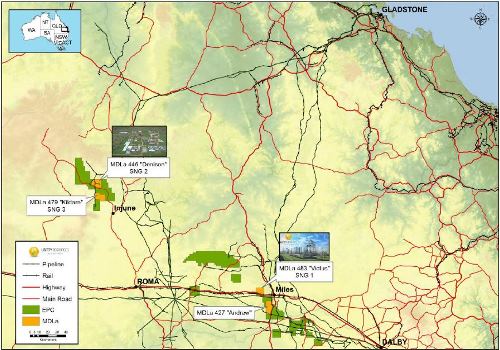
Liberty’s Queensland project locations. Source: Company quarterly report Dec 2012
“If one took a realistic view of the onshore and international appetite for funding new energy supply projects in Australia, it would be hard to go past the locked up potential of Australia’s super funds,” Haythorpe said.
“These funds are holding vast amounts of money, and one would suggest in the current equities environment, earning low or no interest.
“They have a significant portion of their assets ‘parked safely’ in low yielding government bonds at a time government, gas suppliers and industrial and domestic gas consumers collectively face the dire prospect of rising gas and energy prices in the immediate years ahead.
“Yet, while there is some justification in the more intense but somewhat Johnny-come-lately public and government scrutiny of existing and proposed coal seam gas production projects in Queensland and New South Wales, much of these use technologies are now surpassed by the emerging third generation of unconventional gas – what we at Liberty call ‘UGas3’.
“Critically, these new era unconventional gas projects have the potential to meet super funds’ criteria for financial and investment sustainability while delivering the funds’ obligations to meet public expectations of social and environmental accountability in their investment activities and performance.”
Haythorpe declared the potential increase in gas volumes and access offered by UGas3 diminished any need for a gas reservation policy while yielding higher jobs growth and a better managed and respected gas industry.
He said UGas3 could operate at far greater depth – down to 1.5 kilometres – than conventional existing coal seam gas operations, could recover 25 times more energy per area than CSG, and could produce gas at much lower cost, as well as lower electricity from UGas3 fuelled turbines.
Covering all bases, Haythorpe suggested UGas3 could use undrinkable surface saline groundwaters – which has been a problematic subject for the industry – for injecting into the coal seams.
He asserted there were no chemicals involved, and the technology accessed seams beneath the cap rock rather than above it, ensuring the sequestration rather than return to surface, as in CSG operations, of any remnant salt content.
Haythorpe also took aim at the use of shale gas, indicating he felt it was not the full answer to Queensland’s current gas demand of around 240 petajoules.
This demand, he said, faced a 10-fold increase in the amount of gas that has to be produced in the state as LNG projects come on stream over the next three years.
Haythorpe highlighted this as a market pressure point, which reinforced the need for the market to access fresh capital via Australian superannuation funds and the growth opportunity for UGas3 suppliers.
He said while new shale gas projects were a welcome development in Australia’s energy quarter, its challenges included the location of the reserves, the number of rigs in Australia suitable for the specialist shale gas drilling requirements, the longer lead times in well completion and hook up, and import delays on new rigs.
Liberty plans to develop its gas plant in the broader Injune area as a stand-alone development initially but still proposes an eventual world-first $4 billion integrated low cost gas, electricity and fertilizer complex, using UGas3 reserves.
The company has signed a Letter of Intent with global trader and Japanese conglomerate, Marubeni Corporation in regards to the development of its urea and ammonia proposals.
Haythorpe explained Liberty’s technology does not require fraccing as used in CSM.
Instead it injects saline water and oxygen into coal seams to generate natural hydrogen-enriched Syngas to bring to surface from un-mineable coal seams across the company’s tenements stretching in a corridor between Goondiwindi and Longreach.
The surface plant for the project would be able to process the UGas3 to both pipeline and LNG specification gas at estimated costs of $4.50 a gigajoule compared to current industry peer forecasts of $9 per GJ.
The company’s Denison project has an Inferred coal resource of 846 million tonnes with early work pointing to a production of 1000 petajoules (PJ) of raw Syngas per every 100Mt of coal or the equivalent of just under 900PJ per 100Mt of coal when upgraded to pipeline specification gas.