


Antipa Minerals has eyes on development
THE CONFERENCE CALLER: Antipa Minerals managing director Roger Mason told the 2013 Australian Copper Conference in Brisbane the company’s Calbre discovery may well have the potential to take the company from being an explorer to a developer.
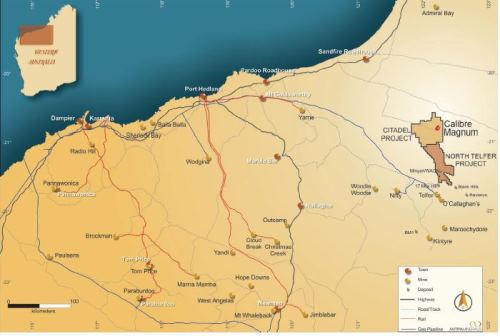
Antipa Minerals (ASX: AZY) owns the 3,000 square kilometre Citadel exploration project in Western Australia.
Source: Company presentation
It is located 400 kilometres east of Port Hedland and just 20km north of Newcrest’s Telfer gold and copper mine and project stretches for 115km north to south as one continuous package.
“It is interesting just to reflect that if you took that package and placed it over the Eastern Goldfields of WA,” Mason said.
“it would extend from the St Ives goldfield all the way to 30 kilometres north of the Kanowna Belle gold mine, picking up Kambalda Nickel and the Kalgoorlie Super Pit along the way.
“The reason we believe this is important is that it is giving Antipa, statistically, a very strong chance and excellent opportunity to make several significant mineral discoveries in what is a grossly under-explored, world-class mineral province.”
The Citadel project hosts the Magnum Dome mineral camp.
The area is just 30 square kilometres in size, but RC and diamond drilling conducted by Antipa on six prospects, all within one to four kilometres of each other has delivered three mineral deposit discoveries, including Calibre, Magnum and Corker.
The Calibre prospect was Antipa’s second greenfield discovery last year with the first drillhole at the prospect intersecting gold-copper-silver-tungsten mineralisation.
“We have completed just six drill holes at Calibre, all of which intersected semi-continuous mineralisation over, virtually, their entire length – generating intersections between 250 to 450 metres in length,” Mason said.
Highlights of this drilling included:
– 373.3m at 0.67 per cent copper equivalent (CuEq);
– 450m at 0.5 per cent CuEq;
– 87.2m at 1.05 per cent CuEq; and
– 76m at 1.05 per cent CuEq.
So far drilling carried out by Antipa at the Calibre deposit has encountered mineralisation along 200m of strike across a width of up to 400m horizontally and to a depth below surface of 450m.
This mineralisation remains open in all directions, including across strike.
Mason said the Calibre mineralisation has, to date, correlated extremely well with the prospect’s magnetic anomaly, which is 800m long by 600m wide and extends to a depth of over 600m.
“Publicly-available, independent research reports propose that, depending on cut-off grade, the Calibre deposit could host between 50 to 300 million tonnes and 2.5 to 6.3 million gold-equivalent ounces,” Mason said.
“In copper terms, that is half a million tonnes to 1.3 million tonnes of copper equivalent.
Mason said geophysical surveys conducted at Calbibre suggest the deposit may continue to increase with depth.
This is most likely to occur at the 254 metre-long Conductor 4, which is the largest downhole EM anomaly Antipa has identified at either Magnum or Calibre.
With a conductivity three to four times higher than the region investigated by the existing Calibre drillholes, Mason intimated an increase in sulphide mineralisation – and therefore grade – could be expected.
In addition the company has noticed the gold grade at Calibre has been increasing significantly as it moves to the north.
The northern-most drill hole at Calibre generated the company’s best intersection to date and included a bulk intersection across the entire hole of 274 metres at 0.75 per cent copper equivalent.
“Whichever way you look at Calibre it is emerging as a very large, low-grade deposit – potentially amenable to open pit or underground bulk mining methods, with the potential to transform Antipa’s future,” Mason said.
The Antipa exploration team is scheduled to recommence drilling at Calibre next week to with the aim of testing the higher-grade targets and to also provide support to, what the company’s considers to be, large tonnage potential of the deposit.