


Queensland Government to reform Resources Act
CONFERENCE CALLER: As part of his address to the second-day audience at The 2013 Gold Coast Resources Showcase, Robert Milbourne of law firm Norton Rose Fulbright said investors should be aware of the introduction of the Queensland Government’s Common Resources Act (CRA).
The Queensland Government is proposing to replace the State’s five current Acts with the single Common Resources Act by 2016.
The Act will include multiple resource-specific regulations and will envelop the Mineral Resources Act, the Petroleum and Gas Act, the Petroleum Act, the Greenhouse Gas Storage Act, and the Geothermal Energy Act.
Milbourne said he considered the new Act would an improvement on the current status quo in Queensland and, although information regarding the Act has not been widely disseminated, it is important to maintain discussion about it.
“It is important for the resources investor to be aware this is happening,” Milbourne said.
“The government has made clear that their intent is that no existing rights will be jeopardised, in fact, there probably will be a strengthening of certain rights of resources investors and resources companies in project development in Queensland.
“Given the significant overhaul, I think this is perhaps one of the most ambitious legislative reforms I have seen.”
The reforms stem from electoral promises made by the Newman Government to reduce resources-related red tape by 20 per cent.
The Government recently completed a Streamlining Approvals project, which it claimed identified the benefits that could be achieved by the single-Act regulation of resource tenures.
The upshot was the current Queensland resources legislation had become unnecessarily complex and inefficient, which in an article by Clayton Utz lawyers Andrew Smith and Ben Cansdale was said to ha come as a result of having historically separate tenure regimes for minerals and petroleum, and cumulative amendments to legislation being made over time rather than genuine reform.
“The Government undertook an analysis of similar mining jurisdictions to compare various models of tenure legislation, and concluded that a model adopting a single Act with multiple resource-specific regulations was the preferred reform approach,” Smith and Cansdale wrote.
According to the Clayton Utz lawyers the Queensland Government has claimed the new Common Resources Act stands to be the most significant reform to Queensland’s resources legislation in over 150 years, and is aimed at harmonising the tenure processes and streamlining regulatory administration.
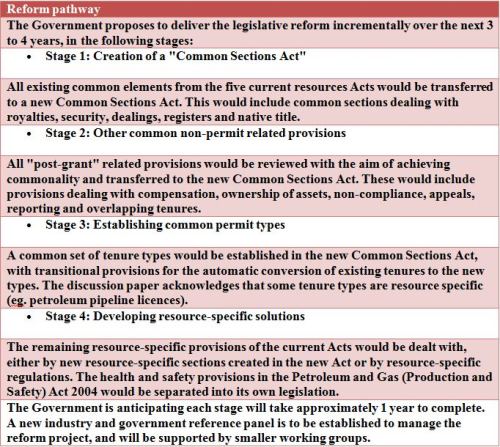
Source: Clayton Utz
“This will have an impact on many projects and it is something you do need to be alert to,” Milbourne said.
“It’s a good sign, in that the government will ultimately reduce the amount of legislation.
“The idea is to reduce the number of pages by 20 per cent…but in addition to that it really is aiming to simplify how the resources industry is regulated in Queensland.
“So in three or four years, we really may have best-in-class legislation, which is a very good sign.”