


South Australia joins call for Mineral Exploration Tax Credit scheme
IN THE LOBBY: The South Australian Chamber of Mines and Energy (SACOME) is the latest state-basd lobby group to claim a Federal minerals exploration tax credit (METC) scheme is essential to inject some life into the exploration said of the mining sector and stimulate the Australian economy through job creation.
The METC is a tax reform initiative SACOME believes will enable Australian junior minerals exploration companies with no taxable income to voluntarily pass current losses on to Australian resident shareholders in the form of a tax credit.
This, it says, will provide a strong incentive for shareholders to commit capital to the exploration sector, making investment in the junior sector companies more attractive and addressing the lack of start-up capital in a competitive market.
SACOME has been calling for an exploration tax credit scheme since before it was first promised by the Rudd Labor Government in 2007 and subsequently dropped upon development of the mining tax.
“Many people do not realise that the junior sector is critical to resource development, being the ‘engine room’ needed to find the mineral resources upon which the economy is so dependant,” SACOME chief executive Jason Kuchel said.
“An METC policy will reinvigorate Australia’s mining sector, which has recorded a drop in share of worldwide exploration over recent years – from around 21 per cent of world exploration spend in 1996 to just 12 per cent in 2011.
“This decrease, combined with softening commodity prices and the constrained capital markets we are experiencing right now, is providing an extremely challenging environment for our junior resources companies trying to develop their deposits into economical projects.”
In 2008 SACOME councillor and taxation expert Alice McCleary developed an METC model suitable to Australia, based on Canada’s highly-successful Flow Through Shares scheme which has resulted in that country growing its exploration spend to 18 per cent in 2011 and hosting more mining companies than any other country in the world.
The industry preferred Australian model designed by Dr McCleary has also been adopted and championed by the Association of Mining and Exploration Companies (AMEC).
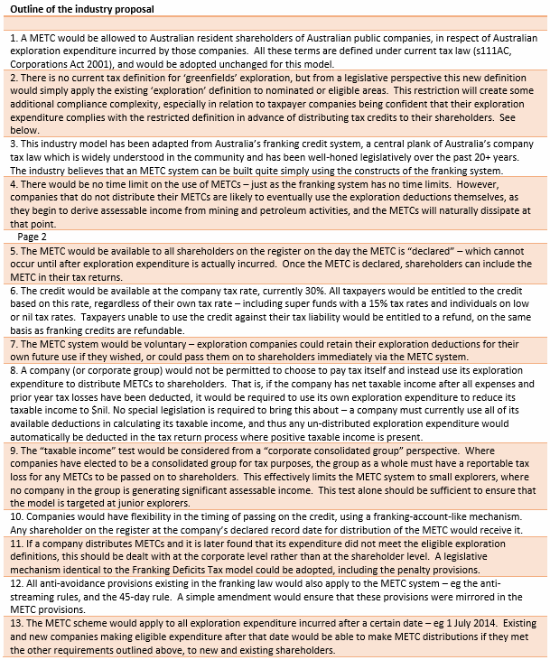
This model is based on Australia’s franking system and has several key advantages, including the minimisation of administrative and tax compliance costs, minimisation of risk for investors and minimisation of distortions between shareholders.
“The key aspects of the model are that it aligns with current taxation laws – minimising additional red tape; it provides a credit to shareholders which are akin to franking credits; it is only eligible to junior explorers; and it stimulates investment in greenfields exploration to discover the mines of tomorrow,” Kuchel said.
According to SACOME, the additional economic activity and taxation revenue created by the introduction of a METC would offset the cost of the scheme, and could potentially add billions of dollars to GDP.
This was supported by a recent KPMG report, which found that at a minimum, the scheme would create 534 jobs across the exploration and associated mining services sectors and contribute $231 million to GDP.
If some of the exploration resulted in viable projects, flow on effects could support over 4,000 jobs across the sector and up to an additional $2.2 billion in GDP.
Source: SACOME.