


Allan Trench: Is Mean Reversion Pricing Inevitable
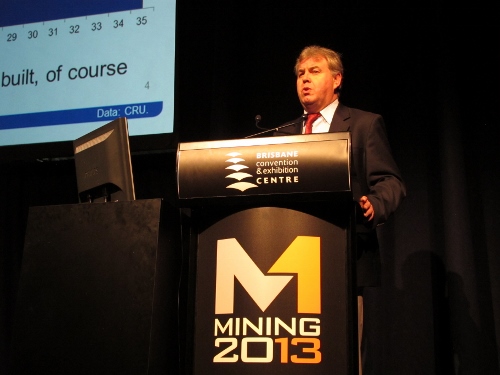
THE CONFERENCE CALLER: Opening the first day of the Brisbane Mining 2013 Conference CRU associate consultant Dr Allan Trench said he was obviously wearing his economics hat when he came up for the title of his presentation.
“Is Mean Reversion Pricing Inevitable is economic speak for ‘is what’s up going to come down, and is what’s down going to come up?’ The short answer is yes,” he said.
Trench said he believed the mining industry was far from dead and that exports continued to be strong.
“The margins in iron ore in particular are amazing, for the majors in particular, but also for the juniors,” he said.
“More money is actually made out of Port Hedland [via iron ore] in one year, at present time, than has been made out of Kalgoorlie in all its history.
“So if you had a choice between iron ore and gold right now, you would probably rather be in the iron ore business.”
Turning his attention to gold, Trench quoted the Spandau Ballet classic song named after the precious metal, which claims it is indestructible, always believing and bound to return.
“That really is where gold is,” he said.
“If we look at gold in a more economic level – what is happening in the gold market at the moment – the good news is central banks are still buying…with Russia leading the pack.”
Russia may be leading the buying pack, but it is China that Trench said is heading the production stakes.
“China is the largest producer now,” Trench said.
“I worry about the future of the Australian gold industry…CRU’s view is along the lines of the consensus view in that as the United States economy emerges from its debt mountain gold will not stay around its current levels, slightly lower even.
“A weakened Australian Dollar means that the Australian gold industry will still probably live on an A$1400 gold price, so we need to be able to make money at those prices.”
From gold it was a quick switch to copper, which he indicated was likely to produce a slight surplus for the global market his year.
“We are still above the cost curve on copper, which is good news,” Trench said.
“Price per tonne still starts with a 7 [over US$7000 per tonne], which is really great news.
“CRU’s view, unfortunate from a miner’s perspective, is that the likely global balance projections are predicting a modest surplus going forward.”
India has long been touted as a driver for global demand for metals, and according to Trench copper demand in India was likely to be reasonably strong.
Although many analysts for some time have been anointing India to be the ‘next China’, Trench said the most likely place to earn that accolade would be China, in particular the development of central and western China.
“What we are anticipating is the coastal strip [of China] moving closer to OECD type levels of urbanisation and the central and western areas of China to move towards eastern China levels of urbanisation,” he said.