


Corazon deciphers Top Up Rise secrets
Having recently completed a $3 million raising, Corazon Mining (ASX: CZN) is well-funded to continue its exploration program at the company’s Top Up Rise (TUR) project.
For the uninitiated, TUR is located in the Gibson Desert region of Western Australia, an area reasonably new in terms of exploration activity, especially when compared to the more familiar of the State’s mining hubs.
TUR first came to prominence in the mid-1990s when Australian Government geologists discovered what they described to be a large granite alteration system.
At the time TUR was noted for its size – as being big by Australian standards – with chemical characteristics considered to be typical of world-class copper gold systems.
Earlier this year, Corazon completed a detailed ground gravity survey at TUR which extended the anomaly to 10 kilometres by six kilometres.
“The variation in the responses of the gravity amplitudes we received was staggering,” Corazon Mining managing director Brett Smith told The Resources Roadhouse.
“We had variations of up to 18 milligals, usually if you receive a three milligals variation that is considered to be quite significant.
“A peak residual gravity of eight milligals was repeated several times, so whatever it is we have there is quite defined and it is starting to develop a particular geological identity.
“It is coming up hard against interpreted faults from the magnetics and we are starting to understand it more in terms of geological definition.”
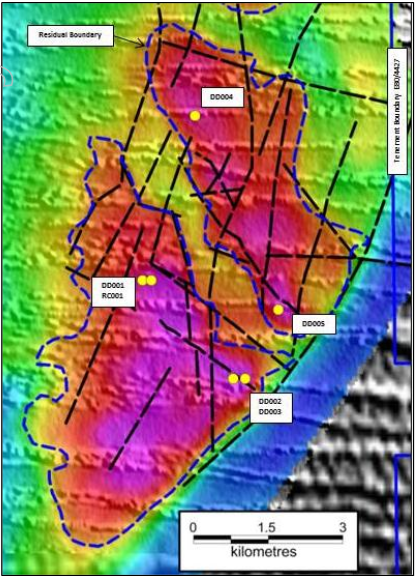
Corazon recently conducted its first phase of drilling at TUR, the results from which suggest the large gravity anomaly has a coincidental geochemical anomaly, including a robust base and precious metal association.
The aim of the drilling program was to drill shallow holes using an aircore rig, in what the company had predicted could be sand cover of around 100 metres, to test the basement geochemically and then return to drill deeper holes.
Instead it encountered about five metres of sand dune cover and was drilling straight into flat-lying, hard premium sandstone, resulting in an immediate rethink to the program.
“Luckily we were using a rig that was capable of drilling all the methods we required,” Smith explained.
Corazon had identified 11 targets for drilling, but decided it would be best to select its best four gravity targets and set about drilling those.
All four holes, spaced widely apart, encountered extensive low-tenor sulphide mineralisation, including copper sulphide, demonstrating that mineralisation at TUR covers a very large area.
Importantly, drilling revealed a precious and base metal association between copper, lead, zinc, cadmium, silver and gold, however, the source of the TUR gravity anomaly remains unexplained.
The limited drilling completed so far, and the types of rocks encountered by Corazon are yet to shed any clear light on the TUR gravity anomaly.
Although the company accepts the density of these materials may be increased via significant and substantial alteration and/or mineralisation, it is yet to intersect such rock in a scale substantial enough to explain the anomaly.
“We discovered a big area with a small drilling program, and every area we test-drilled had sulphide mineralisation,” Smith said.
“Some of the holes are five kilometres apart, which means we have only tested a small part of what is a very large target area.
“There is an over-riding and robust base and precious metal association and what we are seeing here – wherever we drilled – it looks like this gravity anomaly is also a geochemical anomaly.”
Inspection of the core from the first diamond drill hole caused a flurry of excitement, as it was sprinkled with blebs of chalcopyrite measuring up to three millimetres in diameter and less commonly as coarser crystals on the margins of quartz veins or faults.
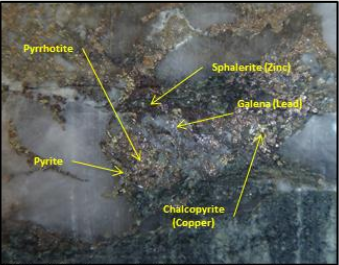
Smith said the company considers this chalcopyrite to be an alteration affect, as it is appearing at around one per cent of the rock mass.
“We’re not saying this is a mineralising event, we are saying it is a significant alteration feature right through the entire geophysical anomaly,” he said.
“Quite obviously there is a late alteration phase, which is associated with chalcopyrite, but in addition to that we have several other phases of mineralisation.
“We see granite and porphyry sources for the fluids that we see in the mineralisation, and we also see mafic sources for the fluids, so there is a lot happening.”
As the drilling progressed, Corazon moved to the southeast and drilled its priority target, which had been identified as being a higher intensity alteration.
Drilling here produced evidence of garnet, which has been interpreted to indicate the presence of a higher-temperature metamorphism, or alteration.
Having encountered massive sulphides, the company extended the third hole of the program hitting some interesting looking rock.
“We didn’t quite understand it,” Smith said.
“We knew it was a gabbro, but it was unusual.”
Corazon’s petrologists identified the rock as a troctolite, which is a very rare form of gabbro.
The significance of troctolite is that out of all the gabbros, it has the potential to host nickel-copper-magmatic-type deposits with the best example being the large Voisey’s Bay nickel deposit in Canada.
A troctolite is a rare differentiated mafic rock, which is considered an important host unit at Voisey’s Bay and is also found in other large layered mafic terrains such as the Bushveld Igneous Province in South Africa.
Petrological analysis of sulphides within the Troctolite at TUR has identified pentlandite (nickel sulphide) within pyrrhotite.
Corazon considers the identification of the Troctolite and pentlandite as significant as it unlocks the possibility of nickel-copper sulphide deposits within differentiated mafic rocks as a target deposit, as separate to the mineralisation observed at TUR so far.
“We don’t fully yet understand the distribution of this rock type, nor how significant it is in the region,” Smith explained.
“We’ve got a big geophysical anomaly, we’ve added a lot of value with limited drilling into ground that has never been explored before, and we have taken a conceptual geophysical anomaly into something that is mineralised.”
Corazon is back out in the field conducting further exploration consisting of a reverse circulation (RC) and diamond core drilling program to test lithological and geophysical targets within the TUR gravity anomaly.
The company anticipates assay results from the drilling to be emerging early in November, with drilling continuing until mid-November.
Corazon has outlined two main objectives for this phase of drilling:
To continue to test for the source of the TUR gravity anomaly, which remains unexplained based on the types and density of rocks intersected to date; and
To test, for the first time, zones of structural weakness and other areas that may be prospective as fluid pathways for the base and precious metals mineralisation identified in the initial drilling at TUR.
“The mineralisation we are seeing and the rocks we have hit, suggest aerial VTEM surveys will work well in the region,” Smith said.
“We think VTEM will influence our targeting – we do have quite a bit of drilling cleared and we have priority drill targets, but we think the ranking of those targets may be affected by this survey.”
Corazon Mining Limited (ASX: CZN)
…The Short Story
HEAD OFFICE
Level 1
350 Hay Street
Subiaco WA 6008
Ph: +61 8 6364 0518
Fax: +61 8 6210 1872
Email: info@corazon.com.au
Web: www.corazon.com.au
DIRECTORS and MANAGEMENT
Clive Jones, Brett Smith, Jonathon Downes, Adrian Byass
SHARES ON ISSUE
401.6 million
MARKET CAPITALISATION
$10.84 million (at 17/10/2013)