


Highfield Resources encouraged by Spanish drilling results
THE DRILL SERGEANT: Highfield Resources (ASX: HFR) has received the initial results from a recently-completed confirmatory drilling campaign on the company’s 100 per cent-owned Sierra del Perdón potash project in northern Spain.
The company has also commenced drilling on its Javier potash project.
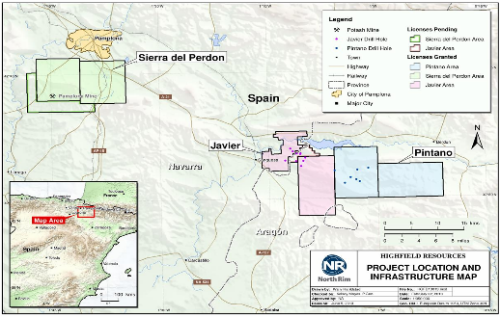
Location of Highfield’s Javier, Pintano and Sierra del Perdón projects in northern Spain. Source: Company announcement
Highfield’s Sierra del Perdón project covers an area of about 80 square kilometres and contains two former operating mines that produced close to 10 million tonnes of potash product between 1972 and 1997.
The company said the initial drill hole of the four hole confirmatory program intersected a thick layer of salt, including what appears to be potassium mineralisation of about 14 metres at depths of 396.05 to 410.05 metres below surface.
Highfield carried out a visual inspection, it said demonstrated the drill core to be consistent with historical mine records and historical drill hole data.
The company said there appears to be a carnallite intersect running from 396.05m to 405.30m with some interbedding of halite, marls and sylvinite in transition.
There is also evidence of a sylvinite intersect running from 405.30m to 410.05m with some interbedding of halite.
“Beneath the sylvinite seam appears to be a halite layer of around 20 metres,” Highfield Resources said in its ASX announcement.
“The recovery of the cores has also been very good with limited dissolution.
“Importantly these results appear to confirm historic reports on the extent of the evaporite and the mining records detailing the extraction of some 37 million tonnes of sylvinite ore and 5.5 million tonnes of carnallite ore from the project area.
“The former operating mines extended to some 35 kilometres of the 60 kilometre project area of the Highfield permits over the evaporite.
“The core is subject to assaying and additional analysis to confirm chemical composition of the salt mineralisation.”