


Talga Resources doubles Swedish iron Resources
THE DRILL SERGEANT: Talga Resources (ASX: TLG) has received results from iron ore resource estimates across the company’s Vittangi project magnetite deposits in northern Sweden.
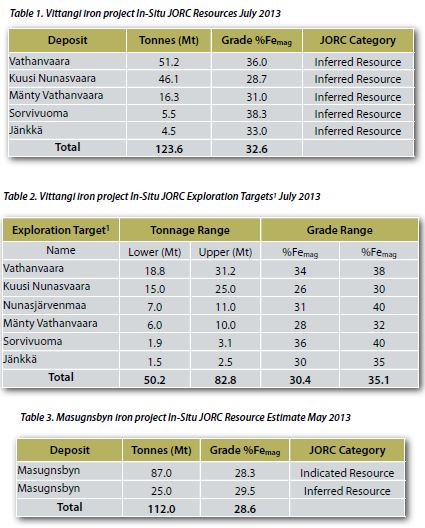
The latest work has provided a maiden JORC Inferred resource estimate of 124 million tonnes grading 33 per cent iron across Talga’s Vittangi project magnetite iron deposits in northern Sweden.
Combining the latest estimate with the company’s existing JORC resource at the Masugnsbyn iron project, 50km southeast of Vittangi, brings Talga’s total Swedish iron resources to 235.6 million tonnes at 30.7 per cent iron.
The historic exploration data has also defined additional JORC code-compliant exploration targets of 50 to 83 million tonnes grading 30 to 35 per cent iron present within the Vittangi project.
“The new Vittangi resources are higher grade than Talga’s Masugnsbyn iron ore project and lie 40 kilometres closer to rail infrastructure,” Talga Resources managing director Mark Thompson said in the company’s announcement to the Australian Securities Exchange.
“The new combined resource across both projects delivers an attractive opportunity for development, joint venturing or sale.
“Both iron projects are contained within the Kiruna mineral district, a mining province hosting the largest iron mines in Europe and are supported by established bulk commodity infrastructure including magnetite concentrators, iron pellet plants, grid power, public access rail and port infrastructure.
“Talga’s priority in Sweden remains development of our high grade graphite deposits, but these new iron results deliver another development or asset realisation opportunity.”
Source: Company announcement
Talga explained the new JORC compliant maiden Inferred Resource estimate stemmed from a recent review of historic drilling, geophysics and other data compiled by the Swedish Geological Survey.
The independently-completed resource estimation reviewed a total of 37 diamond drill holes for 6,055 metres.
The Vittangi iron project falls within the Kiruna mineral district which includes the Kiruna underground iron mine with an annual production capacity of over 26 million tonnes of ore.
Talga said iron deposits in the district typically utilise 25 to 45 per cent iron magnetite ore which is then milled and concentrated to 68 to 70 per cent for domestic steel mills or export markets.