


Corazon Mining intersects massive sulphides at Top Up Rise
THE DRILL SERGEANT: Drilling being conducted by Corazon Mining (ASX: CZN) at the company’s Top Up Rise project (TUR) in the Gibson Desert region of Western Australia has encountered an intersection of a broad zone of sulphide mineralisation, including massive sulphide.
The company undertaking its inaugural drilling program at TUR with the primary target being an unexplored gravity anomaly, which Corazon claims to represent one of the largest amplitude residual gravity anomalies in Australia.
The core of the anomaly measures 10 kilometres by 6 kilometres and is located in an area considered favourable for Iron-Oxide Copper Gold (IOCG) mineralisation.
The third hole of the program has intersected a broad zone of sulphide mineralisation of 193 metres, including predominantly disseminated pyrrhotite, pyrite and chalcopyrite (copper-sulphide).
“The sulphides are hosted in altered amphibolites and quartz-biotite schists, between 288 metres and 481 metres down-hole,” Corazon Mining said in its ASX announcement.
“Within this zone, two intervals (between 326.6 to 329.05 metres and 367.3 to 369.3 metres) exhibit particularly strong sulphide mineralisation, including massive pyrrhotite, pyrite and chalcopyrite.”
Corazon said the drilling it has completed so far at TUR has identified a spatial and timing association between sulphide (particularly chalcopyrite) and magnetite mineralisation.
The company explained this was a positive result as the relationship is typical of distal mineralisation assemblages within many IOCG deposits.
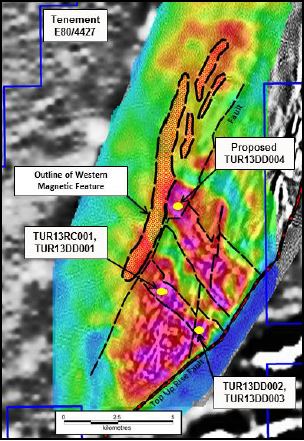
Drill hole location plan – Residual gravity image (colour) over
aeromagnetic image (grey-scale shadow). Source: Company announcement
In June the company announced it had intersected copper mineralisation with its first hole.
The latest hole has intersected greater sulphide mineralisation, including chalcopyrite, than previous holes of the program.
The second hole of the program was abandoned prior to reaching its target depth due to equipment failure down-hole.
However, Corazon said logging of this hole suggests mineralisation was improving down-hole, displaying similarities to the mineralisation intersected within the recently-completed hole.
“Samples from all drilling to date have been submitted for analysis,” Corazon said.
“Results are expected in August.
“Assays have been returned from the initial RC drill hole (TUR13RC001) into the basement.
“Sampled material includes predominantly quartz-biotite schist with minor disseminated pyrite.
“Analysis has indicated there is a robust base metal signature including an association between copper-lead-zinc-cadmium-silver, although, as anticipated, the tenor of metals within these rocks was low.”
Disclaimer: The Resources Roadhouse holds shares in Corazon Mining.