


Sartenga drilling continues to encourage West African
THE DRILL SERGEANT: West African Resources has intercepted primary sulphide mineralisation at depth at the company’s 100 per cent-owned Sartenga copper-gold prospect, situated within the Boulsa project in Burkina Faso.
Results include:
– 45.5 metres at 1.1 grams per tonne gold equivalent (0.5g/t gold, 0.3 per cent copper, 315 parts per million molybdenum), including 15.5 metres at 1.6 grams per tonne gold equivalent to end of hole, (0.7g/t gold, 0.5 per cent copper, 407ppm molybdenum) From 112m downhole with the hole ending in in mineralisation; and
– 36m at 1.0g/t gold equivalent (0.5g/t gold, 0.2 per cent copper, 295ppm molybdenum) from 140m downhole with hole ending in mineralisation.
Shallow copper oxide RC intercepts include:
– 12m at 0.9 per cent copper, 0.2g/t gold from 12m;
– 12m at 0.8 per cent copper, 0.5g/t gold from 4m;
– 8m at 1.2 per cent copper, 0.4g/t gold from 8m; and
– 8m at 0.7 per cent copper, 0.3g/t gold from 16m.
“Confirming primary mineralisation at depth is an important step towards advancing Sartenga to resource status by the end of 2012,” West African Resources managing director Richard Hyde said in the company’s announcement to the Australian Securities Exchange.
“The intersections are at good grade and width, beneath extensive supergene mineralisation near surface.
“Two holes ended in significant gold-copper-molybdenum mineralisation at more than 150m depth.
“The next step is to ascertain how far the mineralisation extends at depth and along strike, to the
southwest and northeast.”
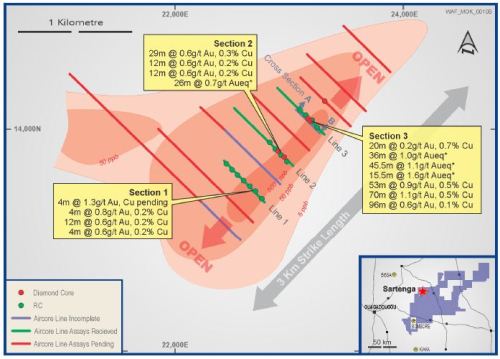
Sartenga cross‐section Line 3 showing drill results. Source company announcement
West African has completed six diamond holes and has received results for two so far, with results from the four remaining holes pending.
“We still have a large amount of results to be reported from completed aircore and diamond drilling,” Hyde explained.
“We are preparing for a follow-up diamond drilling program in the new field season and will also be carrying out preliminary metallurgical testwork oxide and primary mineralisation.”