


Apollo Minerals identifies EM conductors at Titan project
THE DRILL SERGEANT: Apollo Minerals (ASX: AON) has completed a moving loop transient electromagnetic (MLTEM) survey over the Acacia East base metals prospect, which the company claims has identified strong electromagnetic (EM) conductors.
Acacia East is located on Apollo’s 100 per cent-owned tenements, and forms part of the company’s Titan base-precious metals project in South Australia.
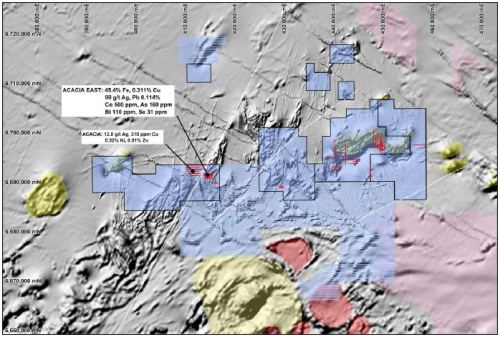
Location of Apollo’s Titan base-precious metals project area and Acacia East prospect. Source: Company announcement
According to Apollo the recently-completed MLTEM surveys delineated large high-strength EM conductors at Acacia East.
These have been measured at approximately 1,200 metres along strike and 800 metres across with a vertical extent of over 1,500 metres.
The company considers the response received by the survey indicates massive sulphide mineralisation, which may be host to significant nickel-copper-platinum group elements or IOCGU mineralisation.
Field XRF analysis carried out on limited outcrop exposures immediately west of the EM responses at Acacia East returned grades of up to:
– 45.4 per cent iron, 0.31 per cent copper, 99 grams per tonne gold, 0.11 per cent lead, 500 parts per million cobalt, 160ppm arsenic, 110ppm bismuth and 31ppm selenium.
Apollo pointed out the presence of selenium is often regarded as a reliable indicator of copper-sulphide based mineralisation.
“Early stage base metals exploration results of this calibre are rare and highly prized,” Apollo Minerals chief operating officer Dominic Tisdell said in the company’s announcement to the Australian Securities Exchange.
“While we’ve still got a great deal more work to do to have a definitive answer to the source of these responses, we’re highly encouraged by what we’ve found so far.
“We’ll be pushing to build the confidence required to drill this promising target as soon as possible.”
The Acacia East prospect is situated approximately three kilometres east of the previously shallowly-drilled Acacia prospect where drilling returned results of up to:
– 12 grams per tonne silver, 0.32 per cent nickel, 310ppm copper and 0.21 per cent zinc.
Acacia East has not been subject to any previous drilling and has had very little geochemical sampling done on it prior to Apollo’s recent program.
In an effort to better understand the thickness and relationship dynamics between the various conductors, Apollo completed a detailed ground gravity survey in February 2013.
Final results from the gravity survey are expected shortly and will be used to more accurately determine the exact mineralisation system-style and to help with drill hole planning.