


Gascoyne Resources increases gold grade and resource at Glenburgh
THE DRILL SERGEANT: Gascoyne Resources (ASX: GCY) has released a remodelled resource estimate for the company’s 100 per cent-owned Glenburgh gold project in the Gascoyne province of Western Australia.
The combined Indicated and Inferred Resource at Glenburgh now stands at 21.1 million tonnes at 1.5 grams per tonne gold for 1 million ounces of gold (using a 0.5 g/t cut-off).
Highlights from the re-defined resource include:
– A 25 per cent increase in the overall Resource grade to1.5 g/t gold;
– The Indicated resource grade up by 34 per cent to 1.73g/t gold, Inferred Resource grade up by 19 per cent to 1.3g/t gold;
– Resource tonnage decreased by 22 per cent;
– Total contained ounces remain relatively unchanged (down 3 per cent); and
– A higher grade ‘core’ of the resources contains 12.3 million tonnes at 2g/t gold for 791,000 ounces (at a 1g/t cut-off).
“The remodelling of the resource has highlighted a number of significant high grade zones within the overall Glenburgh system,” Gascoyne Resources managing director Michael Dunbar said in the company’s announcement to the Australian Securities Exchange.
“The separation of these higher grade zones from the lower grade alteration halo has resulted in a substantial increase in overall grade, while total contained ounces, remain virtually unchanged.
“This has a significant ‘knock on’ effect to the potential profitability of the material.”
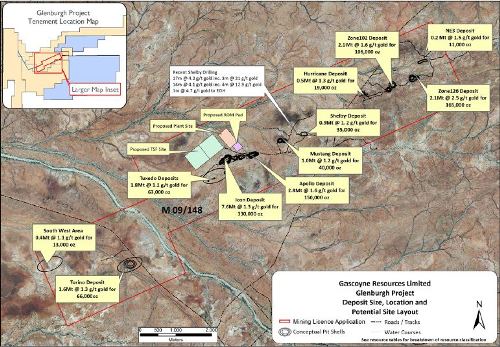
Deposit location, resources and conceptual site-layout. Source: Company announcement
High-grade zones defined by recent work include:
– 523,000 tonnes at 6.3g/t gold for 107,000 ounces (within the Zone 126 deposit);
– 139,000 tonnes at 7.9g/t gold for 35,000 ounces (within the Apollo deposit);
– 521,000 tonnes at 2.8g/t gold for 47,000 ounces (within the Zone 102 deposit); and
– 2.6 million tonnes at 1.6g/t gold for 136,000 ounces (within the Icon deposit).
“In addition to the overall resource refinements, detailed modelling at the Zone 126 deposit has identified a high-grade zone, which not only has the consistency, but also the grade and ounces per vertical metre required to sustain an underground development,” Dunbar said.
“This development could be undertaken in conjunction with the open cut development currently the focus of the Feasibility Study.”
Glenburgh said the Feasibility study is well advanced, with new resource modelling being evaluated with pit optimisations and mine designs.
In addition to the technical aspects of the study, a number of enquiries for second hand plant and equipment are being made, which the company considers could reduce the capital cost of the processing plant from the current new plant cost of approx. $67 million.
The company has current exploration activities continuing with approx. 60 shallow RC drill holes awaiting analysis in Perth and a second phase of drilling expected to commence within the next two weeks.