


Dart Mining deep drilling scores high-grade molybdenum hits
THE DRILL SERGEANT: Dart Mining (DTM: ASX) has reported on a deep drilling program it currently has underway at the company’s Unicorn molybdenum-copper-silver deposit in Victoria.
Dart said the deep drilling program was designed to test the continuity of Unicorn’s mineralisation beyond the boundaries of the current JORC Resource.
The deep drilling has intersected several zones of high-grade molybdenum mineralisation including discrete zones of base metals and, for the first time at Unicorn, indications of gold.
Dart explained its preliminary interpretation of the results had confirmed Unicorn to be similar to the Climax model of multiple high grade stacked mineral horizons.
Assay highlights include:
– 5.2 metres at 0.56 grams per tonne gold, 32.6 grams per tonne silver, 2.53 per cent lead and 3.01 per cent zinc, including up to 1m at 6.32 per cent lead and 6.47 per cent zinc from 498.9m, including 1m at 1.6g/t gold from 502m;
– 1.2m at 671g/t silver and 0.53 per cent tungsten from 620.8m; and
– 2m at 267g/t silver and 0.08 per cent tungsten from 654m.
“Whilst this single deep drill hole within the Unicorn system has not, as yet, seen another high-grade pulse below 750 metres, the intersection of porphyry to a current depth of 1100 metres indicates the system is very large at depth and still shows molybdenum mineralisation within low density quartz veining,” Dart Mining managing director Lindsay Ward said in the company’s announcement to the Australian Securities Exchange.
“The intersection of previously unknown high grade base metals sulphide veining, including anomalous gold, within the system is further evidence of a multi-phased intrusive centre with the potential for a future underground mine at Unicorn.
“The UST’s intersected at 990 metres indicate a new porphyry pulse with potentially additional high grade Mo pulses to the east of the current drill hole, which may suggest DUNDD012 is located to the west of the next series of stacked high grade molybdenum horizons.
“This is not unexpected given we have only drilled a single hole within what is a very large mineralised porphyry system – it is not unusual for porphyry’s of this nature to have had 60 kilometres of drilling completed to prove up an underground resource.
“The deep drilling at Unicorn is still in the very early stages for Dart Mining, with DUNDD012 being the solitary hole below 700 metres.”
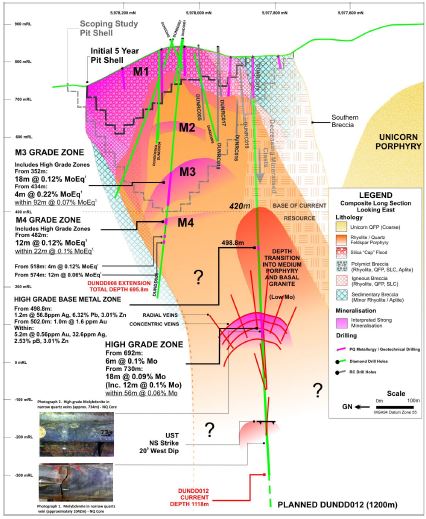
Composite long section looking east showing geological
interpretation, DUNDD008, completed metallurgical/geotechnical drilling
and the second assay results of the second deep drill hole (DUNDD012
–underway). Source: Company announcement
The data also revealed indications of multiple intrusive pulses at Unicorn, which the company has interpreted to confirm the possibility of a large target resource base at depth.
Previous drilling carried out by Dart at Unicorn below 700 metres, had confirmed the continuation of high-grade molybdenum horizons at depth.
Drilling was delayed for approximately five weeks due to a drill rig mechanical breakdown.
The drilling has now recommenced and progressed to a depth of approximately 1100m, with a target depth of 1200m.
The earlier drill sample results between 690m and 750m confirmed the presence of a new high-grade molybdenum horizon from 730m.
This zone sits below what the company has interpreted to be a single porphyritic pulse that shows minor visible molybdenum.
Dart has now systematically sampled this low-grade pulse and has highlighted high-grade base metal veins at a depth of approximately 500m showing significant lead, zinc and silver, and the company’s first intersection of anomalous gold mineralisation.