


Phoenix Gold confirms multiple mineralisation styles at Castle Hill
THE DRILL SERGEANT: Phoenix Gold (ASX: PXG) has received further results from drilling being conducted immediately north east of Stage 1 at the company’s Castle Hill gold project located on the Kunanalling shear zone in the Western Australian Goldfields.
According to Phoenix the drilling has extended gold mineralisation through the tonalite-basalt contact at depth and along strike of the Castle Hill resource, which currently stands at 23.54 million tonnes at 1.6 grams per tonne gold for 1,178,000 ounces.
“The more we drill at Castle Hill the greater our understanding of its potential,” Phoenix Gold managing director Jon Price said in the company’s announcement to the Australian Securities Exchange.
“The latest drilling within the adjoining basalt confirms continuous mineralisation within the tonalite is complemented with higher grade shear hosted mineralisation on the contact and within this basalt.
“With multiple mineralisation styles, orientations, and rocks types in this gold camp starting at surface, the endowment of this area is very robust and clearly justifies our large investment into this emerging new development centre.”
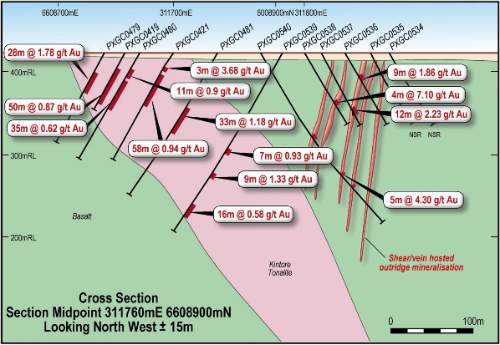
Castle Hill Stage 1 cross section 5. Source: Company announcement
During the recently-completed June Quarter Phoenix drilled a total of 53 Reverse Circulation drill holes totalling 7,444m immediately north east of Castle Hill Stage 1.
The company’s aim for the program was to test the mineralisation in the basalt contact and the basalt itself to the east of the Kintore Tonalite.
Highlighted mineralisation intercepts include:
– 70 metres at 1.7g/t gold from 113 metres;
– 10m at 6.6g/t gold from 67m;
– 31m at 2.7g/t gold from 16m;
– 79m at 1.2g/t gold from 48m;
– 47m at 1.8g/t gold from 107m;
– 2m at 24.7g/t gold from 126m;
– 33m at 1.8g/t gold from 178m; and
– 3m at 11.3g/t gold from 49m.
Phoenix said the drilling has also shown the supergene mineralisation in this area to be more extensive and higher grade than previously identified and provided confidence in the continuity of the high grade quartz veins within the sheared basalt.
The company considers the results to demonstrate mineralisation extends well beyond the Kintore Tonalite showing continuous grade and widths along strike and at depth as well as providing potential for the Stage 1 resource to grow both laterally and at depth with mineralisation remaining open in all directions.